Why Patio Furniture Manufacturers Are Replacing Wrought Iron With Cast Aluminum
To understand why aluminum patio furniture now dominates the casual and premium market, residentially and commercially, it helps to look at a company that made the opposite bet in 1947. That was the year Oddist Lee left his job building custom wrought-iron gates for Pasadena's grand estates and started designing patio furniture instead, using the same hand-forging skills. The company he founded, O.W. Lee, still makes wrought iron today. But most of what they sell now is aluminum. That pattern repeats across nearly every major manufacturer in this industry, and the reasons behind it are consistent enough to be worth walking through in order.
The Wrought Iron Era, and Why It Dominated First
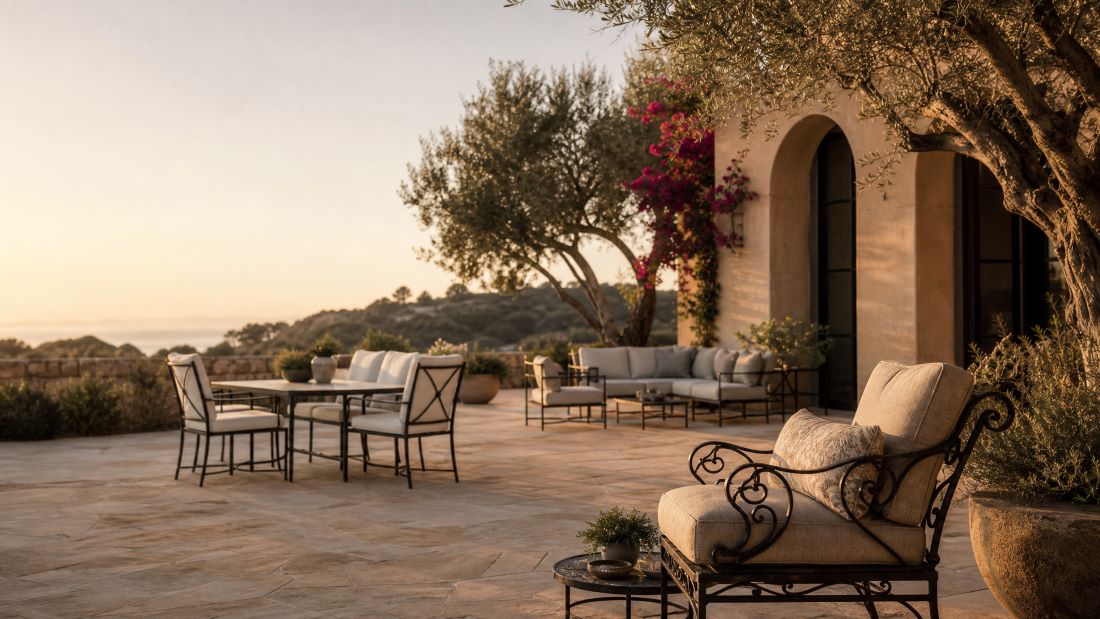
For roughly two decades, from the 1930s through the 1950s, wrought iron was the material of premium outdoor furniture. It was hand-forged, substantial in hand, and capable of the scrollwork and lattice detail that made a patio set look like it belonged next to a wrought-iron gate in the first place. Manufacturers built entire brand identities around it, and for a long stretch of the mid-twentieth century, there was no serious competitor. (For readers who want the direct material tradeoffs rather than the history, our wrought iron vs. cast aluminum comparison covers that ground separately.)

It should be noted that wrought iron also came with real costs that eventually caught up with it. It's heavy enough that shipping it is expensive and rearranging it is a two-person job. It rusts if the finish is ever compromised, which matters in coastal and humid climates where a lot of outdoor furniture actually lives. And hand-forging does not scale well: every scroll and rivet is labor, which caps how much a manufacturer can produce and keeps prices high regardless of demand. None of this made wrought iron a bad material. It made it a material with a ceiling, and that ceiling is what opened the door for aluminum.
Woodard's Pivot: From Depression-Era Necessity to Aluminum at Scale
Woodard is the clearest documented version of this story, largely because the company had already been forced to adapt once before. Woodard started out making wood furniture in Michigan, and when the Depression hit and the region's hardwood and pine supply thinned out, the company switched to metal. Their wrought iron furniture debuted in 1936, and it's what made the Woodard name internationally known for the next several decades.
The aluminum pivot came later, and it was deliberate rather than incidental. Woodard built a dedicated plant, Woodard Crafts in Maxton, North Carolina, specifically to produce extruded aluminum furniture at a scale hand-forged iron could not reach. According to Woodard's own company history, that single investment set the template that Brown Jordan and O.W. Lee would each follow in their own way. The Woodard name carries forward today through Mallin, which Woodard acquired in 2018 and which we carry at Patio Productions.
O.W. Lee: From Custom Iron Gates to Family-Run Aluminum Craftsmanship
O.W. Lee's story is the one we opened with, and it offers the most direct line from wrought iron gate work to a modern furniture catalog built mostly around aluminum. Oddist Lee incorporated the company in 1954 after enough patio furniture retailers requested his designs that it became the actual business, not a side project off the gate work. His son Bob, and later Bob's wife Beverly, spent the 1970s through the early 1990s building O.W. Lee into one of the most respected names in casual furniture, work that earned them a Lifetime Achievement Award from the International Casual Furnishings Association in 2008. O.W. Lee documents this history in more detail on its own company history page.
On one hand, O.W. Lee never actually abandoned wrought iron. Their Classico and Monterra collections carry that heritage forward today, hand-hammered rivets included. On the other hand, the bulk of O.W. Lee's current lineup, collections like Arc, Aris, and Pasadera, is aluminum, or what the company calls wrought aluminum: pieces that borrow the detailing and silhouette of traditional wrought ironwork but are manufactured in aluminum for the weight and corrosion advantages. It's not really a company choosing a side. It's a company selling both answers to the same question.
PRO TIP: If you're shopping and want to know whether a piece is true wrought iron or the newer wrought aluminum, ask directly, or check the warranty terms. True wrought iron typically carries different maintenance guidance than aluminum, since only one of the two materials can rust.
Brown Jordan and the Shared West Coast Lineage
There's a smaller detail in O.W. Lee's founding story worth pulling out on its own. Before Oddist Lee struck out to build gates and then furniture under his own name, he worked as a welder for a company called Brown Williams, the direct predecessor to what became Brown Jordan. Brown Jordan made its own name in wrought iron before it, too, moved into aluminum manufacturing as the broader industry shifted. Two of the most recognizable names in premium outdoor furniture share a family tree that starts at the same wrought-iron workbench, which is the kind of detail I find more interesting than it probably has any right to be. If you want the fuller landscape of who makes what in this industry today, our roundup of the top outdoor furniture brands is a good companion piece to this one.
Why the Shift Actually Happened

Strip away the individual company histories and three reasons show up consistently across every manufacturer that made this move.
- Weight. Aluminum weighs a fraction of what iron does, which lowers shipping costs and lets customers rearrange their own furniture without it becoming a project.
- Rust resistance. Aluminum does not rust, which matters more every year as more outdoor furniture ends up in coastal, poolside, and high-humidity settings where iron's finish-dependent corrosion resistance is a real limitation.
- Manufacturing scale. Aluminum production, whether cast or extruded, scales in a way hand-forged ironwork never could, which is a significant part of why quality outdoor furniture became available at more price points starting in the 1950s.
What We've Seen in Our Own Catalog
We see this same pattern in our own numbers. Patio Productions has carried outdoor furniture since 2007, and the drift is visible in what we've stocked over the years. Back in 2014, we carried hundreds of wrought iron pieces across multiple collections. Today, we still carry over 40 high-quality wrought iron items, real heritage pieces, not a token selection, but that's a fraction of the shelf space wrought iron once held here.
Our sales floor tells the same story in real time. Aluminum questions come up constantly. Wrought iron questions are rare.
None of this made wrought iron obsolete, and I firmly believe it never will disappear entirely from premium outdoor furniture. It is still beautiful, and it is still the right choice for a certain kind of traditional space. But if you are wondering why the aluminum patio furniture aisle grew so much larger while the wrought iron aisle stayed roughly the same size, the answer is these three factors, in this order of importance. For a broader look at how aluminum stacks up against other outdoor materials generally, our guide to the best material for outdoor furniture puts this particular choice in context alongside teak, wicker, and poly lumber.
For the wider arc of how outdoor furniture arrived here at all, our piece on the history of outdoor furniture is a good next stop.
Common Questions About This Material Shift
Yes. O.W. Lee still produces wrought iron collections like Classico and Monterra alongside its aluminum lines. It's a smaller share of the market than it was in the 1940s and 1950s, but it hasn't disappeared, especially for traditional and estate-style outdoor spaces where the hand-forged look is part of the point.
It never fully left. What's changed is that it's now a deliberate style choice rather than the default. Buyers who want a traditional, estate-style look still seek it out, but the practical advantages that pushed the industry toward aluminum (weight, rust resistance, and manufacturing scale) haven't gone anywhere, so aluminum remains the volume material.
Aluminum doesn't rust at all, while wrought iron depends entirely on an intact finish to resist corrosion. Once that finish chips or wears, iron rusts from the inside out. Aluminum's main tradeoff is that it lacks the density and heft of hand-forged iron, which is a look and feel some traditional buyers specifically want.
It's a term some premium manufacturers, including O.W. Lee, use for aluminum furniture designed with the detailing and silhouette of traditional wrought ironwork. It gives buyers the classic look without the weight and rust concerns that come with actual iron.