
Article: Why Aluminum Patio Furniture Chalks and Ages (And When It's Actually a Problem)
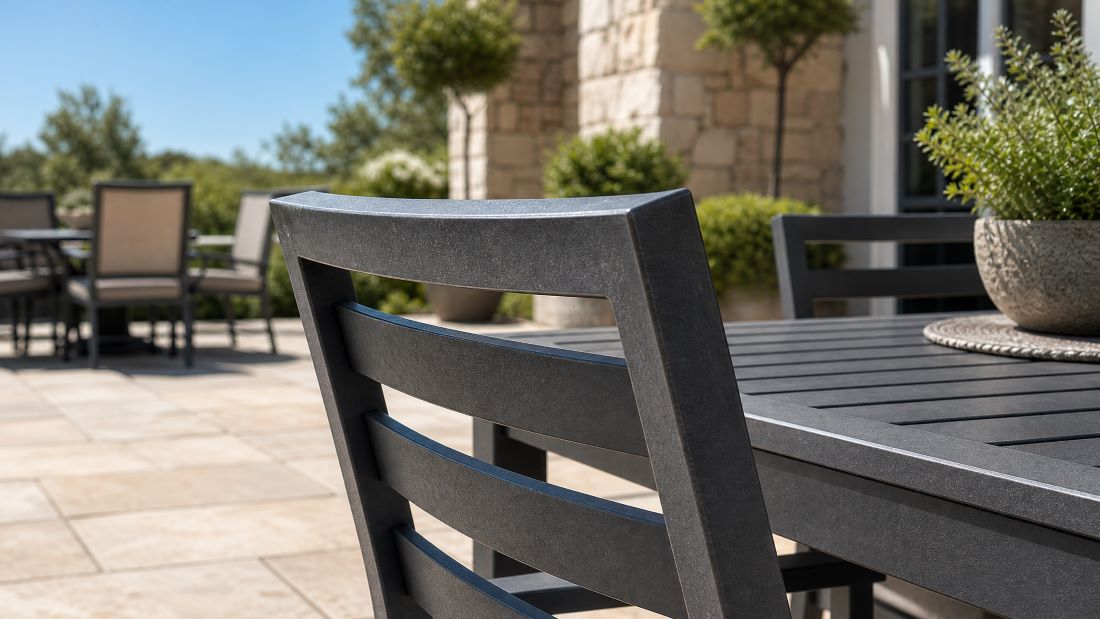
Why Aluminum Patio Furniture Chalks and Ages (And When It's Actually a Problem)
Some chalking (that white powdery corrosion that builds up on aluminum surfaces over time) and dulling on aluminum patio furniture is normal aging, not a defect. What you're seeing is usually one of two things: the powder coat's pigment binder slowly breaking down from years of UV exposure, or the bare aluminum underneath forming its own natural oxide layer. Neither one means your furniture is failing.
We get calls almost every summer from someone convinced their five-year-old dining set is falling apart because it looks a little chalky in bright sun, and most of the time I can tell them the same thing: your frame is fine! That's just what aluminum does after a while outside, and it's not as big a problem as it looks.
There's a real difference, though, between ordinary aging and an actual coating failure, and the two sometimes get confused. So, let's walk through what's chemically happening when aluminum chalks, what a normal timeline actually looks like, and the specific signs that mean something went wrong at the factory rather than in your backyard.
What's Actually Happening When Aluminum Chalks

Aluminum reacts with oxygen in the air the moment it's exposed, forming a thin layer of aluminum oxide on the surface. This is a completely different process from rust. Iron oxide (rust) is porous and keeps expanding, which is why it flakes, bubbles, and eats progressively deeper into steel and iron. Aluminum oxide does the opposite: it builds up a dense, sticky layer that actually seals the metal underneath from further oxidation. On bare or mill-finish aluminum, that's the source of the dull, slightly hazy look you'll notice on old ladders, boat fittings, or any aluminum (like our patio furniture) left outdoors long enough. It's a protective layer, not a decaying one.
Almost none of the aluminum furniture we sell is bare metal, though. It's powder coated, and what most people call "chalking" on a powder-coated piece is a totally different mechanism: it's the pigment particles in the coating losing the resin binder that was holding them together on the surface.
See, UV light breaks down that polymer binder over years of sun exposure, and once enough of it degrades at the surface layer, the pigment particles are no longer bound tightly enough to just stay put. Run a dark cloth across the finish and some of that loose pigment comes off as a fine, chalky residue. The coatings industry actually has a standardized way to measure this exact phenomenon, called ASTM D4214, which rates how much pigment transfers to a cloth under controlled conditions. It's a well-understood, well-documented process with aluminum items, not something unique to patio furniture.
Why Some Furniture Chalks Faster Than Others
Chalking rate isn't random, and it's not the same across every piece of aluminum furniture you'll find on the market. A handful of factors actually drive it.
Coating quality is the biggest one. A true TGIC polyester powder coat, the standard for quality outdoor aluminum, is formulated specifically to resist UV breakdown far longer than a cheaper acrylic or lower-grade polyester finish.
This is exactly where the price difference between a budget aluminum set and a name-brand one shows up years later, even though both look identical on a showroom floor. Sun exposure intensity matters too. A patio in Phoenix or at altitude in Denver sees meaningfully more UV than the same furniture in a shaded courtyard in a cloudier climate, and chalking accelerates accordingly.
Color plays a role as well, though not in the way people usually assume: chalking happens to some degree on every color, but it shows up more visibly on darker finishes like black or bronze, since the pale pigment residue contrasts more sharply against a dark surface than it does against white or a light sand tone.
PRO TIP: If you're deciding between two similarly priced aluminum sets and one manufacturer states a specific chalk-resistance rating or references TGIC polyester by name, that's a real signal of coating quality, not marketing language. Ask directly if it's not listed. The aluminum furniture we sell in our store all come with high grade TGIC, standard.
What a Normal Aging Timeline Actually Looks Like
Most of the brands in our aluminum patio furniture collection back their frames with a 15-year structural warranty, and a quality powder coat is engineered to hold up reasonably well across most of that window under normal outdoor exposure. Here's roughly what that looks like in practice.
In the first one to three years, you shouldn't see meaningful chalking at all on a quality finish. The coating is still fully intact and the binder hasn't had enough UV exposure to break down.
Somewhere around year five to eight, a light haze or slight dulling in direct sun becomes fully normal, especially on darker colors in high-UV climates. It's cosmetic at this stage and doesn't indicate anything is wrong.
By year ten or beyond, more visible chalking is common, and at that point some owners choose to have the piece professionally repowder coated rather than replace it outright, since the frame itself is often still structurally sound.
Every one of these timelines shifts with climate and sun exposure. Furniture on a covered patio that only sees direct sun for a few hours a day will hold its finish considerably longer than an identical set sitting in full, unobstructed sun all day.
When Chalking Actually Signals a Problem

Left: normal chalking. Right: coat failure.
Important to know; chalking within the first year or two, especially heavy chalking rather than a light haze, is not normal aging. That points to a coating quality or application problem at the factory, like an underbaked cure cycle, a low-grade coating formulation, or inadequate UV inhibitors in the pigment itself. If that happens on furniture that's still under warranty, it's worth a call to whoever you bought it from. A coating failure that fast is exactly what a frame warranty exists to cover.
It's also worth knowing that chalking and coating failure are not the same thing, even though people often lump them together. Chalking is surface pigment loss and is purely cosmetic. Bubbling, blistering, or peeling is a completely different mechanism, usually moisture that's gotten trapped underneath the coating through a scratch, a poorly sealed weld joint, or an adhesion failure at the metal surface. That kind of damage can eventually let moisture reach the aluminum itself and is worth addressing sooner rather than later. If you're seeing bumps, flaking, or the coating actually lifting away from the metal rather than just a dusty residue on your hand, that's the problem to flag, not ordinary chalking.
What You Can (and Can't) Do About It
Chalking that's already happened can't be reversed with cleaning, so don't go reaching for a scrub brush. Once the pigment binder has broken down at the surface, no amount of washing restores the original bond; cleaning just removes the loose residue sitting on top, which does make the piece look noticeably better and is worth doing regularly.
Our guide to keeping aluminum patio furniture looking new covers the actual cleaning steps and products in detail, so I won't repeat all of that here. The short version relevant to chalking specifically: a soft cloth with mild soap and water lifts most loose pigment, and a coat of automotive wax afterward can slow future chalking slightly by adding a sacrificial UV barrier on top of the existing finish, though it won't stop the process entirely.
For furniture chalking heavily after ten-plus years of real use, professional repowder coating is usually more cost-effective than replacement, assuming the frame itself is still structurally sound. It's the same process the piece went through originally: stripping the old coating, prepping the bare metal, and applying a fresh coat baked on at the proper temperature.
The Bottom Line
If your aluminum patio furniture looks a little duller or chalkier than it did when you bought it, that's very likely just aluminum doing exactly what aluminum does outdoors over time, not a sign you bought the wrong thing. The frame underneath is almost certainly fine. What actually deserves a closer look is chalking that shows up unusually early, or any bubbling and peeling rather than a dusty surface residue. Everything else is just what years in the sun looks like on a material that, underneath the coating, isn't going anywhere.
If you're shopping for aluminum now and want to understand which brands invest more in coating quality, our roundup of the best aluminum patio furniture brands gets into that directly. And if you're comparing aluminum against other materials before you buy, our guide to choosing the best material for outdoor furniture covers where aluminum fits against wood, wicker, and steel. For more on how manufacturers approach aluminum construction generally, our piece on why manufacturers keep shifting toward cast aluminum is worth a read too.
Chalking and Aging Questions, Answered
Yes, some chalking after five or more years of sun exposure is normal aging, not a defect. It's caused by UV light slowly breaking down the powder coat's pigment binder. It's cosmetic and doesn't affect the aluminum frame underneath.
Chalking is loose surface pigment from a degrading powder coat. Rust is iron oxidation, and it doesn't happen to aluminum at all. Aluminum forms its own oxide layer that's protective and stable, not the expanding, flaking oxidation you see on iron and steel.
That's loose pigment from the powder coat, released as UV light breaks down the binder holding it to the surface. It's the same phenomenon the coatings industry measures with a standardized chalk rating (ASTM D4214). Wiping it down removes the loose residue, though it doesn't reverse the underlying process.
Not on its own. Chalking is gradual, expected surface aging, not a coating failure. A real failure looks like bubbling, blistering, or the coating actually peeling away from the metal, which usually points to trapped moisture rather than simple UV chalking.
No. Visible chalking that early usually points to a coating quality or application problem, not normal aging. Quality powder coats shouldn't show meaningful chalking for at least the first few years. If it's happening within year one, that's worth raising with whoever you bought the furniture from while it's still under warranty.
Slowed, not prevented entirely, since UV exposure is doing the work. A quality coating, regular cleaning, and an occasional coat of automotive wax as a sacrificial UV barrier all help extend the timeline, but any powder coat will chalk eventually with enough sun exposure.
No, chalking is a surface-level, cosmetic process. The aluminum underneath doesn't rust and isn't structurally weakened by pigment loss on the coating. Structural concerns would show up as damage to the metal itself, not as chalk residue.





%20and%20dulling%20on%20aluminum%20patio%20furniture%20is%20normal%20aging,%20not%20a%20defect.%20What%20you're%20seeing%20is%20usually%20one%20o...)