Article: The Complete Patio Dining Chair Buyer's Guide: Arms, Stackability, and Getting the Fit Right
The Complete Patio Dining Chair Buyer's Guide: Arms, Stackability, and Getting the Fit Right
You measured the table. You picked a style you love from our full dining chair lineup. And then six chairs arrive and only four of them actually slide in far enough to sit comfortably, because nobody mentioned that arms add three inches of width per chair. It's one of the most common ordering mistakes we see, and it has nothing to do with taste and everything to do with a few dimensions most people never think to check.
Quick answer: the right patio dining chair comes down to four decisions: arms or armless (this affects both fit and stacking), the correct seat height for your table, whether stackability matters for your storage or turnover needs, and a frame material built to withstand daily use, not just sun exposure. Get those four right and the style question takes care of itself.
Arms or Armless?
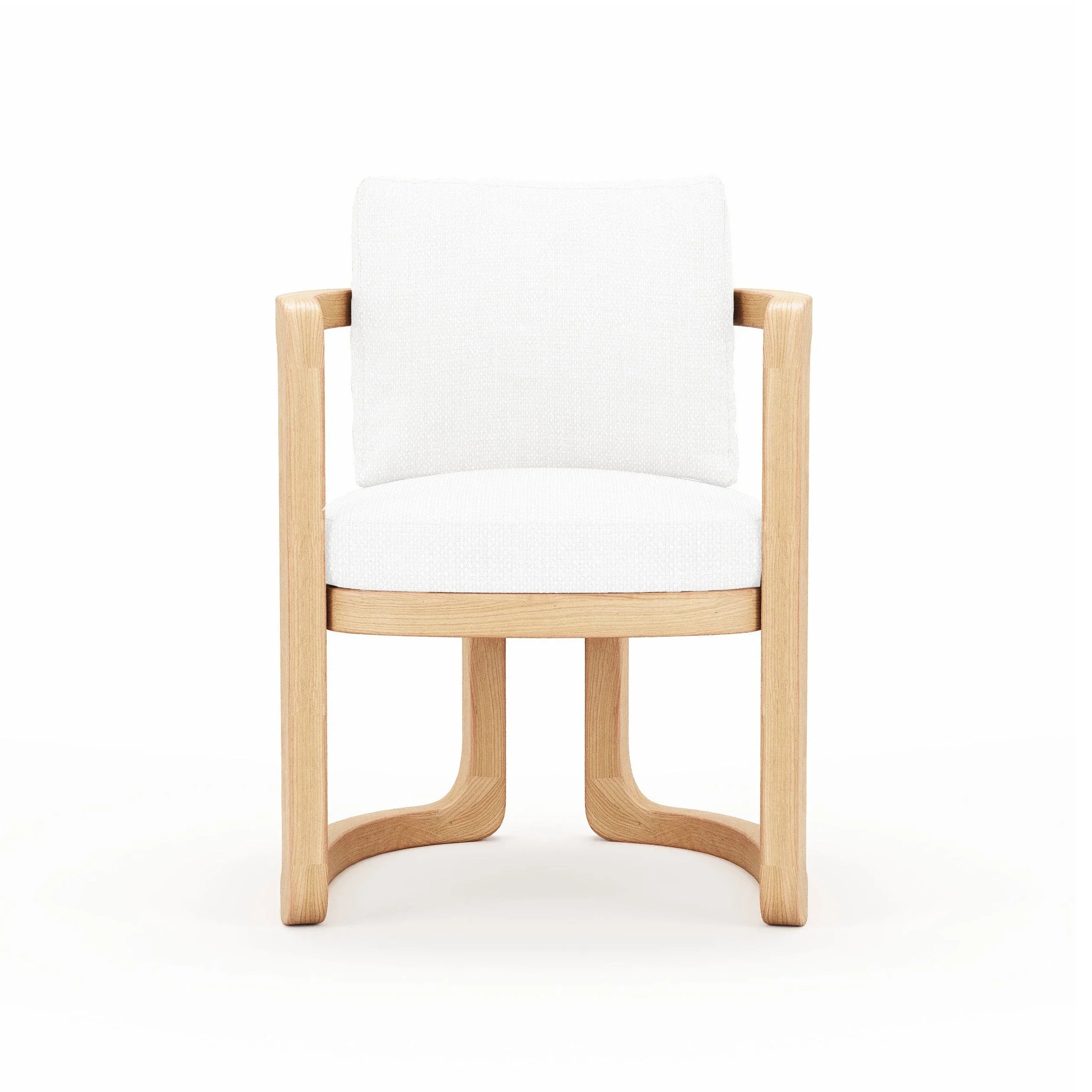
This is the first fork in the road, and it's a bigger decision than it looks. Right now, our own catalog leans pretty heavily toward arms: 279 of our dining chairs have them, against 117 armless options. That split isn't an accident. Arms add comfort and a more substantial, formal look, and a lot of shoppers default to them without a second thought.

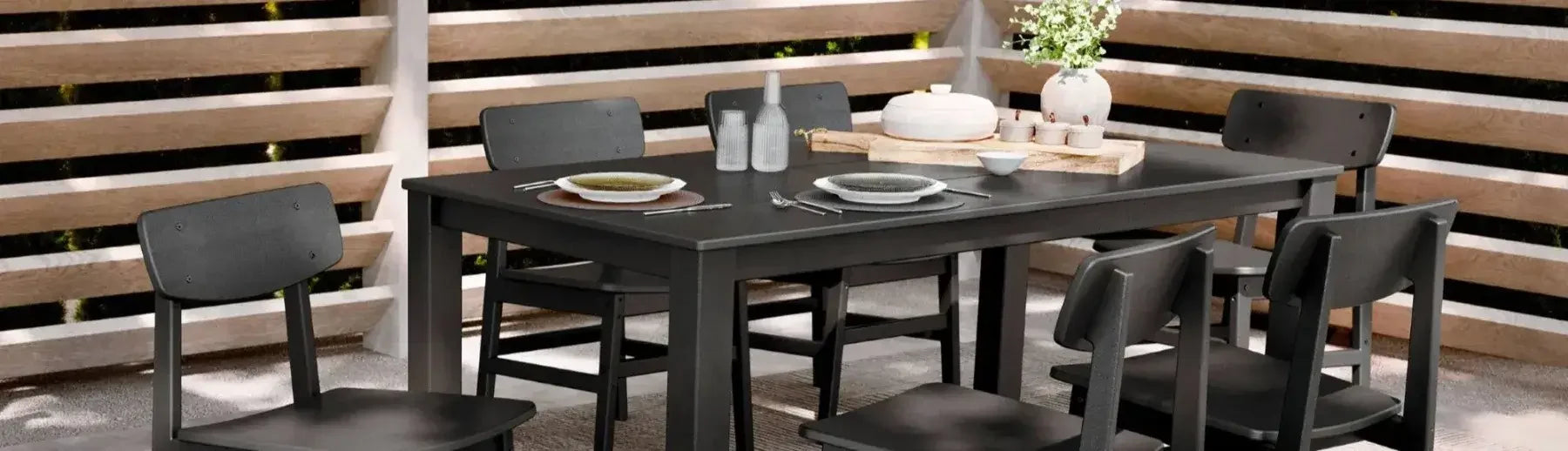
But armless has real advantages that don't show up in a product photo. An armless chair takes up less width at the table, which matters if you're seating six or eight people around a table that isn't enormous. It also slides in and out more easily, since there's no armrest to catch on the table edge or on a neighboring chair. And if stacking is on your list at all (more on that below), armless is almost always the better bet.
PRO TIP: if you're mixing arm and armless chairs at the same table (a common move for a dining set with two "captain's chairs" at the ends), measure your table width first and confirm the arm chairs will actually clear the table edge when pushed in. Three extra inches per side adds up fast on a narrower table.
Browse our full Armless Dining Chairs or Dining Chairs with Arms collections once you've decided which way to go.
Getting the Height Right
Most patio dining chairs sit at standard table height, 16" to 19" at the seat, which pairs with a standard 28" to 30" dining table. If you're setting up a taller counter-height or bar-height dining area instead, the chair height changes along with it, and the spacing between chairs matters too.
We've written a full breakdown of exactly how counter and bar height work (measurements, spacing between seats, how many people fit around a given table size) in our guide to counter and bar height patio furniture, so I won't repeat all of it here. The short version: if your table isn't standard height, don't guess on the chairs. Measure first.
Stackability: Why It Matters More Than You'd Think
Stackable dining chairs get treated like a minor convenience feature, and honestly, that undersells them. For a lot of households, stacking is the difference between storing chairs neatly against a wall for winter and trying to cram six full-size chairs into a garage that doesn't have room for them.
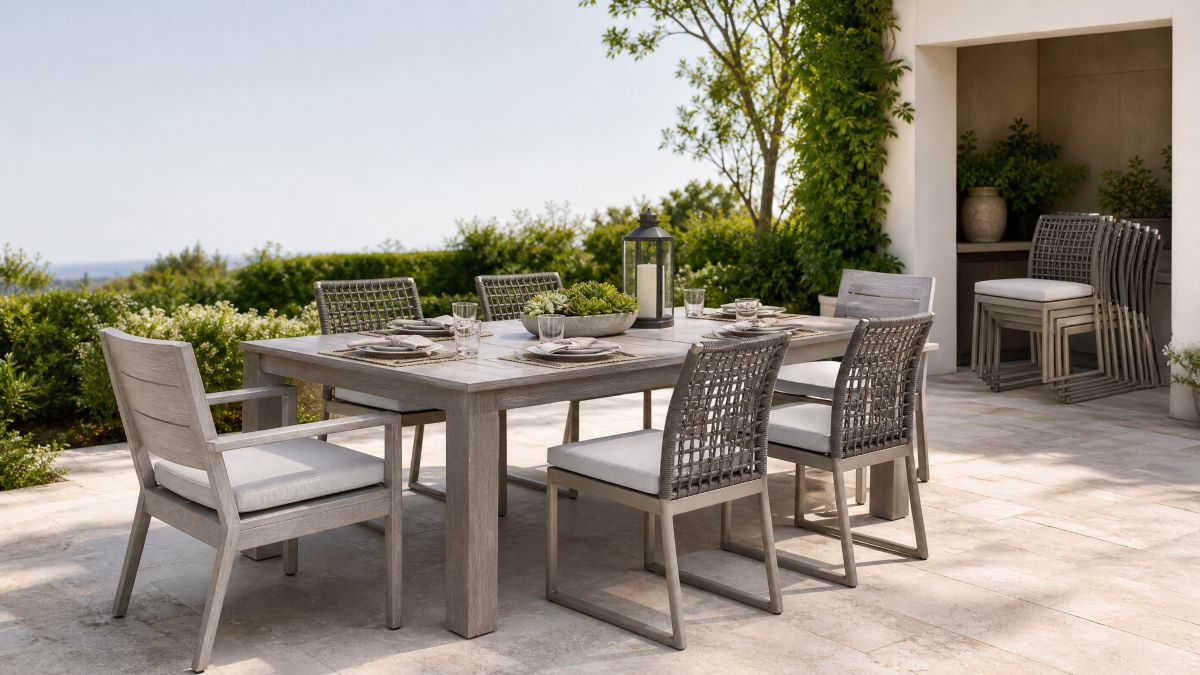
The residential case is simple: off-season storage, and fast cleanup after you've pulled extra chairs out for a party. A stack of eight armless chairs takes up a fraction of the footprint of eight chairs sitting side by side!
The commercial case is a different animal entirely, and it's one we deal with constantly. Restaurants, hotels, and event venues need chairs that can be broken down and restacked between seatings, sometimes several times a day, without the frame loosening up or the finish scuffing. Commercial furniture buyers in this world generally lean on stacking-chair durability standards like ANSI/BIFMA X5.1, which tests structural strength and stability specifically for stacking chair designs. If you're furnishing a patio that gets that kind of daily turnover, it's worth asking a supplier directly whether a given chair has been tested to that standard or an equivalent.
For a real look at chairs built with commercial-grade stacking in mind, our team can point you toward the right options for your property.
Materials Built for Dining, Not Just Lounging

Here's something that doesn't get talked about enough: a dining chair lives a different life than a lounge chair. A chaise mostly sits still and holds your weight while you relax in it. A dining chair gets pulled out, sat in, pushed back in, and repeated for every single meal, sometimes for years on end. That repeated movement puts real stress on frame joints in a way that sun exposure alone doesn't. A hinge or a welded joint that would happily last decades under a stationary lounge chair can loosen up much faster under a dining chair's constant scooting, especially on an uneven patio surface where the legs don't sit perfectly flat. It's a very different kind of wear, and it's exactly why a chair marketed for lounging isn't automatically a safe bet for a dining table, even if the material sounds the same on paper. This is also part of why commercial kitchens and restaurants tend to replace dining chairs on a completely different cycle than they replace lounge furniture. The good news is that a handful of materials are actually built with this kind of movement in mind.
A few materials handle that particularly well:
- Aluminum is the most common dining chair frame material for good reason. It's light enough to move easily, doesn't rust, and welded aluminum joints hold up to years of being scooted in and out.
- Teak is heavier and more substantial underfoot, which some people actually prefer for dining chairs since they don't slide around on a patio surface as easily. It also just gets better looking as it weathers.
- Resin wicker wraps around a metal or resin frame, and the weave itself resists the kind of scuffing a solid surface might show from repeated chair-scooting.
- Poly lumber (HDPE) wipes clean almost instantly, which matters a lot for a dining chair that's going to catch its share of spilled sauce and sunscreen.
- Wrought iron is the heaviest option by a wide margin, which means it won't tip or slide, but it does need more upkeep to keep rust at bay over time.
Whichever you land on, a wipeable seat surface (sling fabric, resin, or a cushion with a removable, washable cover) makes ordinary dining life a lot less stressful than a fixed upholstered cushion would.
How Many Chairs Do You Actually Need
This sounds obvious until you're standing in front of a table trying to figure it out. A standard 4-person table needs exactly that, four chairs, with roughly 24 inches of width per seat if they're armless and closer to 27 inches if they have arms. Step up to a 6-person table and you'll want a rectangular top in the 68" to 78" range, or a larger round table, to fit everyone without elbows colliding. Our dining table sizing guide walks through the table side of this math in more detail.
Once you get to 8-person tables, the math shifts again: you're either looking at a long rectangular or oval table (typically 84" or longer) or two smaller tables pushed together for flexibility at bigger gatherings. If you already know you need seating for six, our 6-Person Outdoor Dining Sets collection is scoped exactly to that size, so you're not guessing at compatible pieces.
Common Questions About Patio Dining Chairs
Not inherently, they're just a different kind of comfortable. Arms give you a place to rest your elbows and can make getting up easier, but armless chairs let you sit closer to the table and take up less space per seat. Comfort mostly comes down to cushioning and seat depth, not whether arms are present.
Not if they're built for it. A well-designed stacking chair uses the same solid frame construction as any other dining chair. The difference is in the leg geometry, which is engineered to nest cleanly. Cheaper stacking chairs can feel wobbly, so check for a chair specifically designed and rated for stacking rather than one that just happens to stack in a pinch.
16" to 19" at the seat, paired with a 28" to 30" table. That's standard table height. Counter and bar height dining setups use taller chairs and tables, with their own separate size ranges.
Aluminum and resin wicker are the most common commercial choices. Both are light enough for staff to reset quickly between seatings and resist the wear that comes from constant use. Look for a chair rated for commercial or contract use specifically, since residential-grade pieces aren't built for that level of daily turnover.
Six chairs, paired with a table in the 68" to 78" range. A round table works too, typically 60" or larger, if you'd rather not deal with corners. Leave roughly 24 to 27 inches of width per seat depending on whether the chairs have arms.
Yes, and it's a common design choice. Arm chairs at the head of the table with armless chairs along the sides is a classic pairing. Just confirm the arm chairs still clear the table edge when pushed in, since arms typically add a few inches of width.
Once you've worked through all four decisions, the chairs that end up getting the most use in your yard are rarely the ones that looked flashiest in a product photo. They're the ones that fit the table properly, stack away easily when you need the patio space back, and hold up to being sat in, pushed back, and dragged around more times than you'll ever bother counting. That's honestly the whole game with dining furniture. Style matters, but it's the boring measurements that decide whether you actually enjoy using the set five years from now.