How to Choose the Right Size Outdoor Dining Table
There are any number of ways to choose the wrong outdoor dining table. Material, finish, and style all matter, but none of them will cause the kind of daily friction that comes from a table that is slightly too large for the patio, seats two fewer people than you actually need, or stands at the wrong height for the chairs you already own. Size is the variable that trips up the most buyers — usually because the decision looks obvious until you are actually standing on the patio with a tape measure trying to figure out why nothing fits the way you imagined it would.
The questions below cover the factors that actually determine the right table dimensions for a given space. Most of the answers involve a few simple measurements and a realistic conversation about how you use your outdoor space. Patio Productions carries outdoor dining furniture across most size categories and seating configurations — but the goal here is to help you arrive at the right size before you start browsing, not while you are already in a showroom trying to visualize a floor plan from memory.

Start With Seating Count — But Not the Number You Think
The first question most people ask is how many people the table needs to seat. The more useful question is how many people you need it to seat on the occasions that actually matter.
There is a real difference between the four people who eat there on a typical Tuesday and the eight who show up in July. Most buyers purchase for the first number. They should purchase for the second. Nobody ever complains that their patio table is too large. They do, fairly regularly, complain that it is too small once guests arrive — and I have personally watched someone try to pass a serving dish across a 48-inch table to eight people without making eye contact with the person whose elbow was already in the salad.
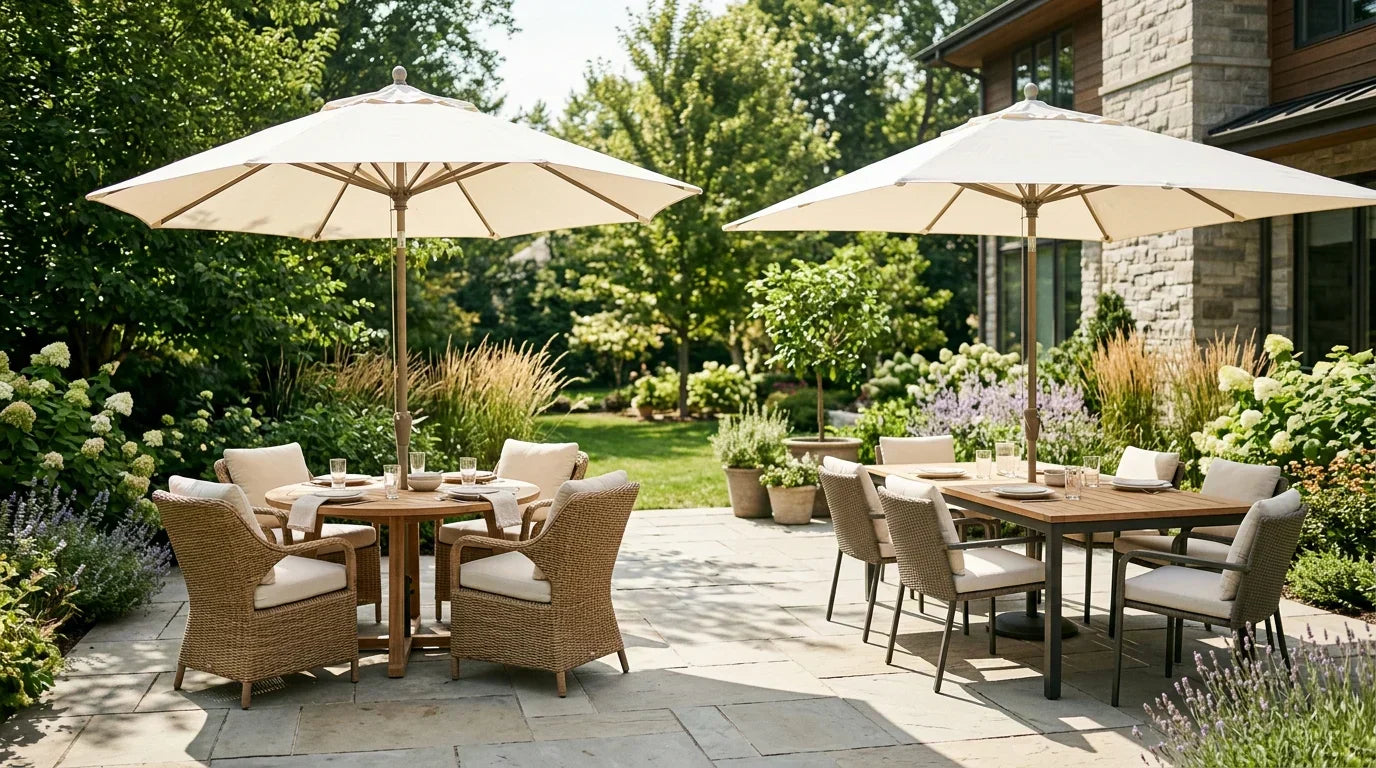
The standard allocation is 24 inches of table length per person seated along the sides. At that figure, a 48-inch table seats four comfortably; 72 inches seats six; 84 to 96 inches accommodates eight. Round tables follow a similar logic: a 48-inch round is a four-top, a 60-inch round seats five or six, and a 72-inch round can accommodate eight — though conversation across a table that wide starts to require some effort.
If you entertain more than a few times per year, the 18 to 24 additional inches separating a four-person table from a six-person one are almost always worth it. The footprint difference is minor. The flexibility difference, when you need it, is not.
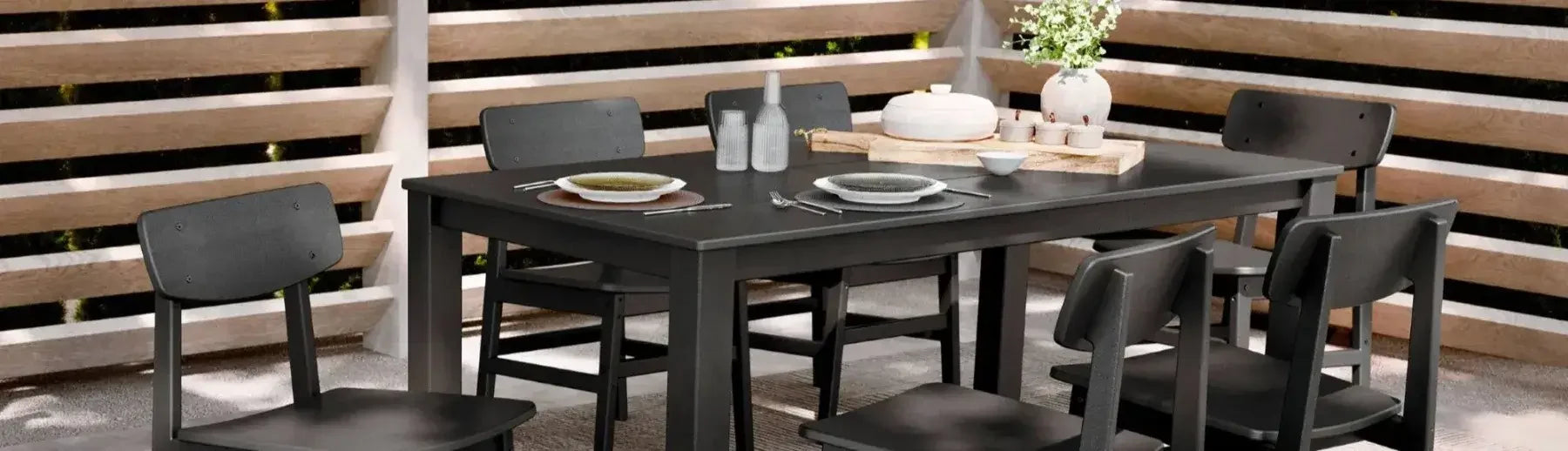
If you've landed on six as your number, our outdoor dining sets for 6 collection is organized specifically around that seat count. For larger gatherings, the outdoor dining sets for 8 collection covers the eight-person range across several shapes and materials.
Measure the Space Before You Measure Anything Else
Once you have a seating count in mind, your patio sets the constraints. This step is the most frequently skipped, and it is the one that generates the most problems.
The clearance standard for outdoor dining is a minimum of 36 inches from the table's edge to any fixed obstacle — a wall, a fence, a planter, a built-in grill station. The National Kitchen and Bath Association recommends 42 to 48 inches where regular pullout traffic is expected. Below 36 inches, chairs begin catching on things and guests stop feeling comfortable moving around the table. Below 30 inches, it becomes actively difficult.
One nuance worth applying: the 36-inch clearance is a traffic zone requirement, not a universal perimeter rule. If one side of your table backs to a wall or railing that nobody walks behind, 18 to 24 inches is functionally adequate there. Apply the full clearance to the sides that see regular movement.
PRO TIP: Before ordering, tape the full footprint of your intended table — including chairs pulled out — on the patio surface. Walk around it. Sit at it. This takes five minutes and eliminates most sizing mistakes before they become expensive ones.
A useful calibration: a six-person table with 36-inch clearance on the two long sides and 24 inches at each end requires approximately 144 square feet of functional floor space — a 12-by-12-foot zone. If your patio can absorb that without the table dominating every other use of the space, you are likely in the right range. If that calculation is cutting it close, it is worth looking at extendable outdoor dining tables — a table that sits at four-person dimensions most days but extends to six or eight when you need it can solve a space problem that a fixed table cannot.
Table Shape Affects Space Efficiency More Than It Appears

Rectangular tables are the most space-efficient shape for a given seat count. They seat more people per square foot than any other configuration, which is why they dominate both residential patios and commercial dining terraces. For a patio with defined length — a narrow rectangle, a deck constrained on one long side by a railing — a rectangular dining table works with the geometry rather than against it.
Round patio tables and square tables create a more egalitarian social dynamic. There is no head of the table, everyone is roughly equidistant from the center, and conversation tends to stay more unified across the group. For smaller gatherings of four to six where the social quality of the meal matters as much as raw capacity, this is often the better choice even if the geometry is less efficient. It should be noted that a 60-inch round technically seats six — but "technically" and "comfortably" are doing a fair amount of work in that sentence once you add armchairs.
Oval tables are underused and worth evaluating more seriously. They combine the social geometry of a round table with the capacity of a rectangle, and the curved ends reduce corner clearance problems in tighter spaces. Material also plays into this: a thinner-profile aluminum oval reads quite differently in a space than a substantial teak one of identical dimensions. For a detailed look at how materials affect the visual and physical character of outdoor dining furniture, our outdoor furniture materials guide is worth reading alongside this one.
Height Is a Decision, Not a Default
Outdoor dining tables come in three standard height categories. They are not interchangeable with arbitrary chairs or stools, and pairing them incorrectly is a mistake that only reveals itself after the furniture arrives.
Standard dining height — 28 to 30 inches from floor to tabletop — pairs with chairs measuring 17 to 19 inches from floor to seat. This is the most common residential configuration and the appropriate default when in doubt. It is also the most widely available across outdoor furniture collections, which gives you the broadest selection when it comes time to coordinate seating.
Counter height tables run 34 to 36 inches and require stools or chairs in the 24-to-26-inch range. They work well on narrower patios where a standard-height table would feel visually dominant, and they suit a more casual interaction style — guests moving between sitting and standing without the transition feeling significant.
Bar height — 40 to 42 inches — requires 28-to-30-inch stools. This is the most casual format and appears most often in commercial bar and lounge settings. I firmly believe it is underutilized in residential outdoor design, particularly for small patios and balconies. A compact bar-height two-top requires significantly less visual footprint than a standard dining table and can bring a proper outdoor dining experience to a space that otherwise could not support one. The outdoor bar furniture collection covers this category across materials and styles if this configuration fits your space.
One caution on mixing: if you are buying additional seating to pair with an existing table, verify the height category before purchasing. A 30-inch table paired with a 26-inch counter stool creates an uncomfortable 4-inch gap that makes dining feel awkward in ways that are hard to diagnose until someone actually tries to eat there.
Extension Tables: When Variable Guest Counts Make Fixed Sizing Difficult
If your outdoor dining use shifts considerably — intimate dinners for two on weeknights, gatherings of eight or ten on weekends — an extension table deserves serious consideration. Most outdoor extension tables add one leaf of 18 to 24 inches, which moves you one seat count category upward: a four-top becomes a six-top, a six-top becomes an eight-top.

The argument against extension tables in outdoor settings is that the leaf mechanism can collect debris and develop friction over time, particularly with materials that respond to seasonal humidity changes. Teak extension tables, in particular, can be heavy and require more physical effort to extend than their indoor equivalents — a fact that becomes more relevant the first time you are trying to extend one alone, 20 minutes before guests arrive. For a comprehensive look at how teak performs across all outdoor dining use dimensions, including the extension table question, the teak outdoor furniture buyers guide covers the tradeoffs in detail.
A practical resolution: if you will realistically extend the table more than five or six times per year, the mechanism earns its cost and occasional maintenance. If the leaf would come out twice — a holiday gathering and one summer party — buy a fixed table sized for your typical use and handle overflow with a separate portable table when the need arises.
A Few Brands Worth Knowing
Once you have your dimensions and configuration sorted, the brand question becomes considerably easier to answer. Three manufacturers stand out in the dining category specifically, for different reasons and at different price points.
OW Lee has been making cast aluminum outdoor furniture in the American Southwest since 1947. Their dining collections are extensive — tables and chairs in traditional, transitional, and more contemporary profiles — and they back their frames with a 15-year warranty. If you are looking at cast aluminum and want something with a long track record behind it, OW Lee is the reference point.
Castelle is another cast aluminum specialist, known particularly for the intricacy and consistency of their mold work. Their dining lines lean toward the elevated end: substantial frames, fine surface detail, coordinated seating across a range of configurations. Also a 15-year frame warranty. The two brands frequently come up in the same conversation, and they genuinely do represent different design sensibilities — OW Lee tends toward the clean and transitional; Castelle tends toward the more formally detailed.
Homecrest, made in Wadena, Minnesota, takes a different approach: sling and cushion seating on powder-coated aluminum frames, with 30 active collections and a highly configurable ordering system. Where OW Lee and Castelle are primarily cast aluminum specialists, Homecrest covers a wider range of seating styles and is particularly well-suited to buyers who want specific fabric or finish combinations rather than off-the-shelf configurations. Their frame warranty runs 15 years residential, 5 years commercial.
These three are among the most broadly represented brands in the dining category at Patio Productions, but they are not the only ones worth considering. For a wider view of the outdoor furniture landscape, our Top 10 Outdoor Patio Furniture Brands covers the full field across categories and price points.
Commercial Patios: Where the Same Rules Apply Differently
For restaurant terraces, hotel dining decks, and club settings, the factors above all remain relevant — but the priorities shift in predictable ways.
In commercial settings, cover density matters more than personal clearance. A 30-inch clearance is often acceptable where 36 inches would be standard in a residential context. Tables tend to run smaller: a 30-by-48-inch four-top is a widely used commercial outdoor standard because it maximizes covers per square foot without making guests feel cramped by restaurant standards. Four-tops that can be pushed together for larger parties provide more operational flexibility than fixed six- or eight-tops that cannot be reconfigured.
Additionally, material durability at higher use cycles becomes a primary specification criterion rather than an aesthetic one. Extruded aluminum is the dominant commercial frame material for good reason: it is lighter than cast aluminum, handles higher turnover without accumulating visible wear as quickly, and in some configurations can be stacked for storage. For hospitality and commercial projects where material selection intersects directly with long-term maintenance costs, Teak vs. Cast Aluminum Outdoor Dining Furniture walks through the full comparison.
The commercial patio furniture collection at Patio Productions includes dining tables and chairs specified for higher use cycles. For larger projects or patios with specific spatial constraints, the Patio Productions design team offers free consultations — and a second set of eyes on a floor plan tends to surface options the measurements alone would not have revealed.
For general residential shopping, the outdoor dining sets collection is organized by size and seating count, which makes it straightforward to cross-reference options against the measurements you have now established.
Frequently Asked Questions
For six people, plan on a rectangular table of at least 72 inches in length. At the standard allocation of 24 inches per person along the sides, a 72-inch table seats six with reasonable elbow room; 78 to 84 inches is more comfortable if space allows. A 60-inch round table will technically seat six, though the seating at the curves is tighter than it appears in product photography. For a patio that needs to flex between four and six, an extendable table starting at 60 inches is a practical middle ground.
The standard minimum is 36 inches from the table edge to any fixed obstacle — wall, fence, planter, or built-in structure. The National Kitchen and Bath Association recommends 42 to 48 inches on sides that see regular traffic. The 36-inch figure is a traffic zone requirement, not a universal perimeter rule: a side that backs to a wall or railing with no one walking behind it can work at 18 to 24 inches. Apply the full clearance to the sides where people will be pulling chairs in and out throughout a meal.
Counter height tables measure 34 to 36 inches from floor to tabletop and pair with stools or chairs in the 24-to-26-inch seat height range. Bar height tables run 40 to 42 inches and require 28-to-30-inch stools. The two are not interchangeable — pairing the wrong seat height with either table format produces an uncomfortable gap or an awkward perch. If you are replacing or adding seating to an existing table, measure the table height first and calculate the corresponding seat height before shopping.
It depends on the material and how the extension mechanism is engineered. Aluminum extension tables are generally low-maintenance — the metal does not swell or contract significantly with humidity changes, and the slides stay smooth with minimal care. Teak extension tables perform well but require more physical effort to extend and benefit from occasional lubrication of the mechanism, particularly after wet winters. Extension tables from quality manufacturers are designed for outdoor conditions; the mechanism is not an afterthought. Where problems arise is with lower-grade tables where the extension hardware was not built to weather constant outdoor exposure.
For small patios, the right shape depends on the patio's geometry. A narrow rectangular patio typically works best with a rectangular table — it orients naturally along the length and leaves the most usable clearance space. A square patio with balanced proportions can support a round table without losing too much floor area, though the 36-inch clearance requirement applies on all sides simultaneously. For very small spaces, consider a bar-height two-top: the compact footprint and the visual lightness of a taller, narrower table can make a modest balcony or terrace genuinely functional as a dining space.