What Size Patio Umbrella Do You Need? It Depends on the Table's Shape, Not Just the Seats
Two feet, that's the rule: your umbrella needs to clear the table's edge by about two feet on every side, or you're chasing shade around the table all afternoon. I'd stop there if it was only that simple, but it isn't, because I've sold enough umbrellas to know the two-foot rule works great on a round table and then falls apart on a rectangular one, which is most dining tables built for six people or more.
Table shape and umbrella shape are two separate decisions, and most sizing charts size by table diameter and leave it at that. That's fine for a round table, not so fine when your table's rectangular. Here's the breakdown organized the way people actually shop, by seat count first, then by shape, with the actual math behind why shape changes the answer.
And if you are looking for a more robust overall guide on getting the perfect umbrella for your outdoor living space, check out our Ultimate Patio Umbrella Buyers Guide - it'll get you armed with all the knowledge you'll need to get the perfect shade for your backyard.
The Two-Foot Rule (and Why It's Not the Whole Story)
Every umbrella brand I've dealt with agrees on the baseline: the canopy should extend past the table edge by roughly two feet on every side. Less than that, you're moving your chair to stay in the shade by 2pm. More than that, and you're catching wind you don't want and paying for canopy you don't need!

That baseline, 2 foot rule of thumb is totally clean math on a round table under a round umbrella, since every point on the edge sits the same distance from the center. It gets more complicated the second your table stops being round, and it depends on which direction it gets more complicated, which is the part worth actually walking through instead of just hand-waving.
PRO TIP: Measure your actual seating area, not just the tabletop. Chairs usually pull out another 6 to 8 inches past the table edge, and that's really where your two feet of overhang needs to start.
Round Table, Round Umbrella: The Simple Case
On a round table, the math is exactly what you'd expect: table diameter plus about four feet.
| Table Seats | Typical Table Diameter | Recommended Umbrella Diameter |
|---|---|---|
| 4 | 36–42 in | 7–8 ft |
| 6 | 48–54 in | 9 ft |
| 8 | 60–72 in | 10–11 ft |
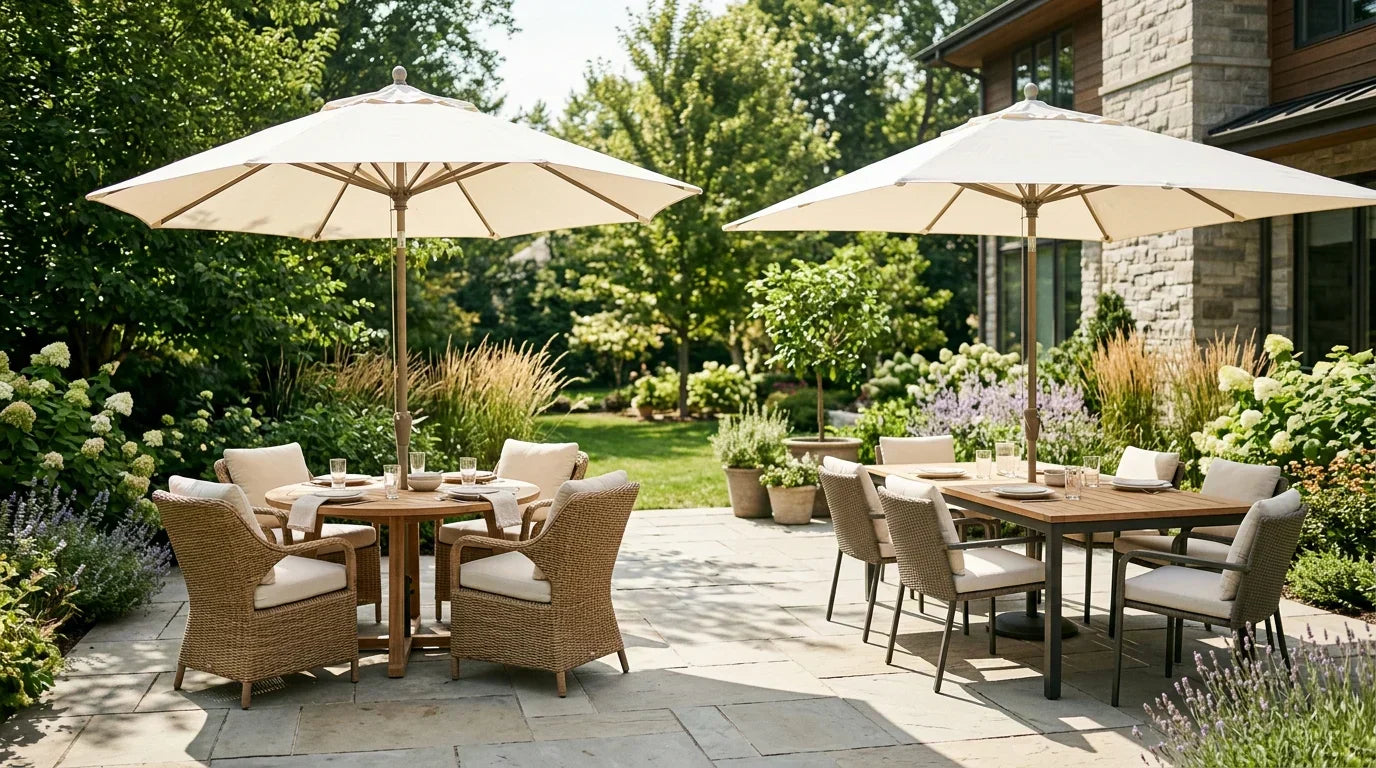
Our round outdoor dining tables run the full range above, most with a center hole ready to go, and a market umbrella, the classic pole-through-the-table style, is the straightforward pairing here. Nothing fancy needed.
Rectangular or Square Table? The Corners Change the Math
Here's where we need to start thinking outside the box... er, circle. A round umbrella centered over a rectangular table has to clear the corners, not the sides, and the corners sit farther from the center than the sides do. That distance is the table's diagonal, and it's bigger than most people guess by eye.

A 6-seat rectangular table at roughly 75 by 38 inches has a diagonal of about 84 inches, not 38. Add the standard four feet of overhang and you need an 11-foot round umbrella to actually clear those corners. That's a big umbrella for what most people would call an ordinary dinner table, and a 4-seat rectangular table needs a round umbrella almost as large as what an 8-seat round table uses. Same rule, different shape, and a VERY different result.
Square tables get the same treatment, just a smaller version of it. A square still has corners and a diagonal, so a round umbrella still has to clear that diagonal, it's just not stretched out the way a long rectangle's is. Take a 40-inch square table seating four: the diagonal runs about 57 inches, and with the standard four feet of overhang that calls for roughly a 9-foot round umbrella, noticeably bigger than the 7 to 8 feet a round table seating the same four people needs. Match a square umbrella to a square table and the penalty disappears entirely, back to simple side-plus-four-feet math, same as round-on-round.
A rectangular or square umbrella skips the whole problem on a matching table, because its length and width scale to the table independently. No diagonal penalty, no oversized umbrella you didn't budget for. If I'm buying for a rectangular or square table myself, I'm matching the umbrella shape almost every time.

That said obviously you might LIKE the round umbrella with a parallelogram table. That's fine! Just understand you may need your umbrella to be a little wider than you may initially expect. Or, go for two umbrellas covering opposing corners.
Sizing Chart: Rectangular Tables, Round vs. Rectangular Umbrella
| Table Seats | Typical Table Size | Round Umbrella Needed | Rectangular Umbrella Needed |
|---|---|---|---|
| 4 | ~54 x 32 in | 9–9.5 ft diameter | ~6.5 x 9 ft |
| 6 | ~75 x 38 in | 11 ft diameter | ~7 x 10 ft |
| 8 | ~90 x 40 in | 12–13 ft diameter | ~7.5 x 11.5 ft, or two umbrellas |
PRO TIP: At 8 seats, most manufacturers stop making a single round umbrella that large, and for ver ygood reason: wind load on a canopy that size gets hard to manage safely on one pole. A rectangular umbrella, a cantilever off to the side, or two smaller umbrellas down the table length all solve it better than hunting for a 13-foot round canopy that barely exists. Our rectangular outdoor dining tables pair well with either approach.
The Base (and the Hole) Matter Just as Much as the Canopy
Bigger canopy, more wind, heavier base required.
Rough baseline: 50 pounds minimum for a 9-foot umbrella, 80 to 100 pounds recommended. 80 to 100 pounds, or a cantilever's dedicated cross-base, minimum, for anything 11 feet and up (and we recommend our solid stainless steel 150lb bases at that point).
When wind gets into what the National Weather Service's Beaufort scale calls a "moderate breeze," roughly 13 to 18 miles per hour, that's your cue to close or lower the umbrella, base weight or not. A double-top or vented canopy lets wind pass through a gap at the crown instead of catching it like a sail, and on anything 9 feet or bigger, I treat that vent as close to required, not optional. It costs a little more, and every time someone skips it to save forty dollars and calls us after a bent frame, I think about that trade differently than they did going in. This isn't really about the umbrella breaking, because most frames are made of powder coated aluminum and hold up just fine; it's about the whole thing tipping over with a full pitcher of lemonade on the table, which is the ACTUAL scenario nobody wants. Undersized bases are, hands down, the most common regret I hear about once summer storms show up.

The other question, and it's the one people forget to ask before they fall for a tabletop: does your table even have a hole? You can't safely drill one into glass or stone after the fact. If you're shopping table and umbrella together, check for the hole first. If your table doesn't have one and never will, a cantilever umbrella (read: what is a cantilever umbrella?) puts the pole off to the side instead of through the table, and our cantilever umbrella collection is built for exactly that, worth a look even on a table that does have a hole since a cantilever also makes it easier to move shade around during the day. One more thing on wind: if you want the deeper rundown on why double-top and vented umbrellas work the way they do, we wrote a separate piece on exactly that.
Umbrella Sizing Questions People Actually Ask
Depends more on shape than seat count, honestly. A 4-seat round table (36-42 inches) wants a 7-8 foot round umbrella. A 4-seat rectangular table, around 54x32 inches, actually needs a bigger round umbrella, close to 9 feet, to clear its corners, or a 6.5x9 foot rectangular umbrella fits the same table better.
A 6-seat round table (48-54 inches) pairs with a 9-foot round umbrella, straightforward. A 6-seat rectangular table (about 75x38 inches) needs an 11-foot round umbrella to reach the corners, or roughly 7x10 feet if you go rectangular instead.
Round 8-seat tables (60-72 inches) generally pair with a 10-11 foot round umbrella. Rectangular 8-seat tables push you into 12-13 foot round umbrella territory, which is a lot; I'd go rectangular, cantilever, or two smaller umbrellas before I'd hunt for a canopy that size.
Yes, just size up. The round umbrella has to clear the diagonal, corner to corner, not the table's width, so it needs to be bigger than the simple "plus four feet" math would suggest. Numbers are in the chart above.
Round table, measure straight across the center. Rectangular table, measure length and width, and if you're leaning round umbrella, measure the diagonal too, corner to corner, since that's what the umbrella actually has to clear.
Only if you want a market-style pole umbrella. A cantilever puts the pole off to the side entirely, so it works on tables with no hole: glass tops, stone tops, anything you don't want to drill.
About 50 pounds for 9 feet, 80 to 100 pounds, or a cantilever cross-base, for 11 feet and up. Wind matters more than people budget for. An undersized base is the single most common mistake I see.
It follows the rectangular rule, not the round-table one. A square table still has corners and a diagonal, so a round umbrella still has to clear that diagonal, just a smaller penalty than a long rectangle. A 40-inch square table needs roughly a 9-foot round umbrella, bigger than the 7 to 8 feet a same-size round table needs. Match it with a square umbrella instead and the penalty goes away.
None of this takes an engineering degree, it just takes matching two shapes correctly before you buy either piece. If the table isn't picked yet, start there: our outdoor dining sets collection is worth a look before you shop umbrellas, since the umbrella math follows from the table, not the other way around. And once you've got the right size sorted, keeping it in shape is mostly upkeep: we've got guides on cleaning and repairing a patio umbrella for the rest.
I get a lot of customers who walk in dead set on "the biggest umbrella you've got." Almost none of them actually need it! They need the right one for their table, and once you know the shape math above, that's usually a five-minute conversation instead of an hour one.