We've Furnished Dozens of Restaurant Patios With Commercial Furniture. Here's What We Learned.
Furniture doesn't fail all at once on a restaurant patio. It fails one bolt, one frayed strap, one wobbly leg at a time, usually right around the point a good residential set would still look showroom-fresh in someone's backyard. Multiply that by three seatings a night, seven days a week, and you get a pretty fast education in what "commercial grade" actually means.
If you already know what you're after, our restaurant patio furniture collection has everything organized by category. If you're still figuring out what your patio actually needs, keep reading: since 2007 we've furnished patios for restaurant concepts as different as Hooters and Truluck's, and here's what dozens of those installs have taught us about buying furniture for this specific kind of space.
What Restaurant Owners Ask Us Most
Volume and frequency of use, not appearance. A restaurant patio might turn over three seatings a night, every night, for years, and residential furniture isn't built to survive that. Commercial-grade pieces use heavier-gauge frames, finishes rated for institutional traffic, and fabrics that hold up to bleach cleaning. Most manufacturers back commercial frames with a separate warranty from their residential line, which tells you how differently the two are actually engineered.
Dining sets sized to your seating plan, bistro tables for tighter corners or sidewalk seating, and shade or heat (often both) to keep the space usable outside of perfect weather. Furniture covers and cushion storage matter more than people expect, since overnight weather exposure is what actually kills commercial cushions early.
Powder-coated aluminum, for almost every application. It's light enough for staff to rearrange between seatings, it never rusts, and most major manufacturers back it with a 15-year structural warranty. If your patio sits right on the water or gets hosed down daily, poly lumber shrugs off moisture and salt air better than any painted metal. Wrought iron holds up best in high-wind coastal spots, where lighter aluminum pieces tend to walk away in a storm.
No, and we'll tell you which pieces aren't. We stock both residential and true commercial-spec furniture, and we work directly with owners and buyers to make sure what ships actually matches the traffic level of the patio, not just what looks similar in a catalog photo. If a piece isn't rated for commercial use, we say so before you order it, not after it fails in month three.
About two weeks for in-stock items, longer for custom fabric. In-stock pieces typically ship within 14 business days domestically, and our Quick Ship cushion fabrics run 7-10 business days. Custom Sunbrella fabric or nonstandard configurations usually add two to four weeks.
Yes, and this comes up on almost every project. Your patio is a branding signal before it's seating capacity. We work with Sunbrella's library of 200-plus fabrics to match a specific palette, and our design team can suggest collections and configurations that fit the tone you're going for, whether that's an upscale steakhouse look or a laid-back taco shack feel. There's no charge for this consultation on commercial orders.
Yes, orders of 10 or more units of a single item get automatic volume pricing at checkout. For a full patio outfitting or a multi-location rollout, it's worth calling us directly instead of building a cart online. We negotiate with manufacturers on pricing and lead times for large orders, and we've been doing this long enough to know which brands can actually deliver on tight commercial timelines.
Small independent restaurants, mostly. Most of our restaurant clients are furnishing one location, not a fifty-unit rollout, and there's no minimum order size to get commercial-grade quality or trade pricing consideration. A four-table sidewalk patio gets the same attention as a fifty-table build.
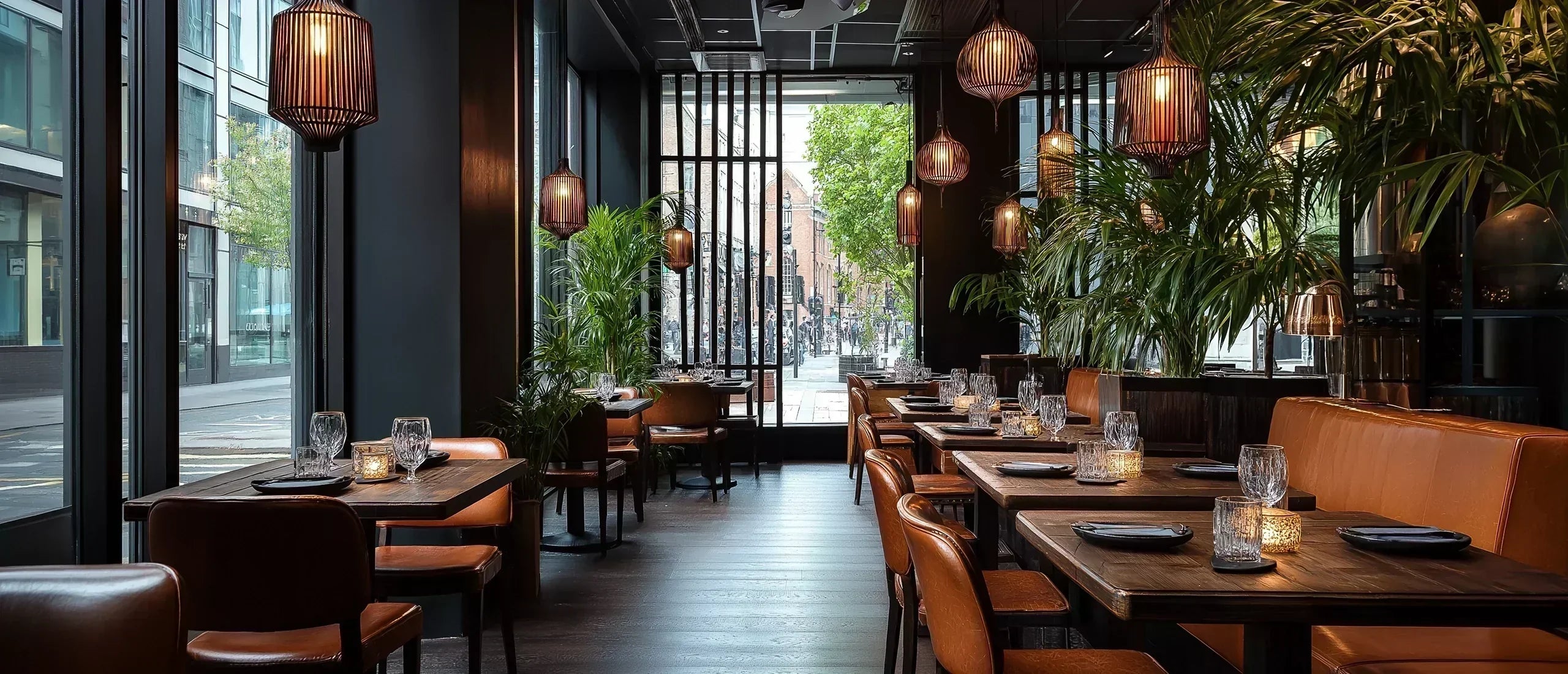
We've furnished patios for fine-dining rooms, fast-casual counters, sidewalk cafes, and just about everything shaped like a restaurant in between, and the throughline is the same. Guests don't care what your furniture cost. They care whether it's comfortable and clean when they sit down, and whether it's still comfortable and clean the following week.
Start With Seating: Dining Sets and Bistro Tables
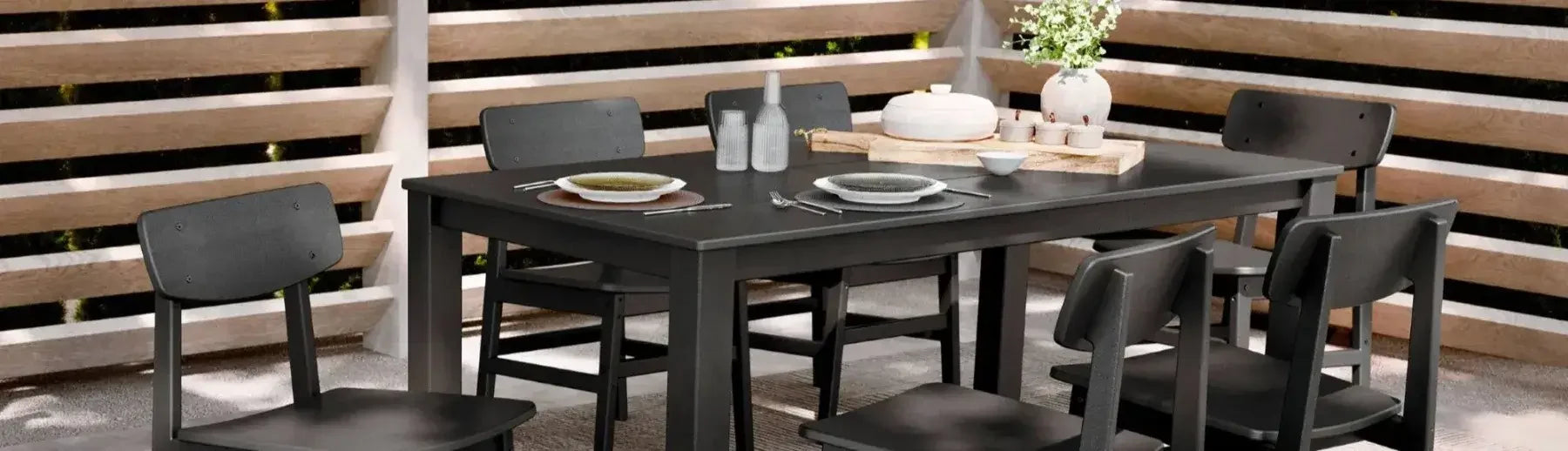
Industry-standard restaurant spacing calls for roughly 24 inches of table edge per guest and about 36 inches between chair backs so servers can actually move. Get that math wrong and no amount of furniture quality fixes it. Full dining sets are the backbone for a sit-down patio, and commercial dining chairs in a restaurant setting almost always mean stackable sling or mesh designs, since a two-person crew needs to reset an entire patio between lunch and dinner service in about twenty minutes. Homecrest's Allure Mesh, Manhattan Steel, and Echo Steel lines are built specifically for that cycle. For sidewalk cafes, wine bars, and tight corners where a full dining set doesn't fit, smaller bistro tables and chairs do more with less square footage, and they're worth specifying just as carefully, since they're often the tables that turn over fastest of anything on the patio.
Shade Solves the Lunch Rush, Heat Solves the Dinner Rush
Shade and heat solve two different problems, and most restaurant patios eventually need both. Direct midday sun kills lunch service in the summer unless there's real shade to sit under, and commercial-grade market umbrella bases (some go up to 150 pounds) hold up in real wind without sandbags or improvised anchoring. On the other end of the day, patio heaters and fire pits are what keep a patio profitable once the temperature drops after sunset. Any commercial fire feature needs to clear local fire code before installation, which in most jurisdictions means following NFPA guidelines on top of whatever your city requires, so loop in your fire marshal early rather than after the equipment shows up. When you're ready to shop this part, our commercial patio umbrellas and commercial patio heaters collections are organized around exactly this.
Lighting Is the Cheapest Way to Extend Your Hours
A restaurant patio that goes dark at 7pm loses its best tables right when dinner service should be picking up. Layered lighting fixes that without much expense: string or bistro lights overhead for ambiance, low path lighting along steps or transitions so nobody trips on the way to the restroom, and something warmer than a bare porch light directly over the tables. Skip the single bright overhead fixture if you can manage it; it flattens the mood and makes the food photograph worse, which matters more than it used to now that half your table's photos end up online before the entrees do. Dimmable string lights on a timer are the easiest upgrade most patios haven't made yet. And if you're already adding heaters or a fire feature for the shoulder season, the warm glow does double duty as lighting, which is one more reason restaurants tend to plan heat and light together rather than separately.
Commercial Grade Isn't a Marketing Word, It's a Spec
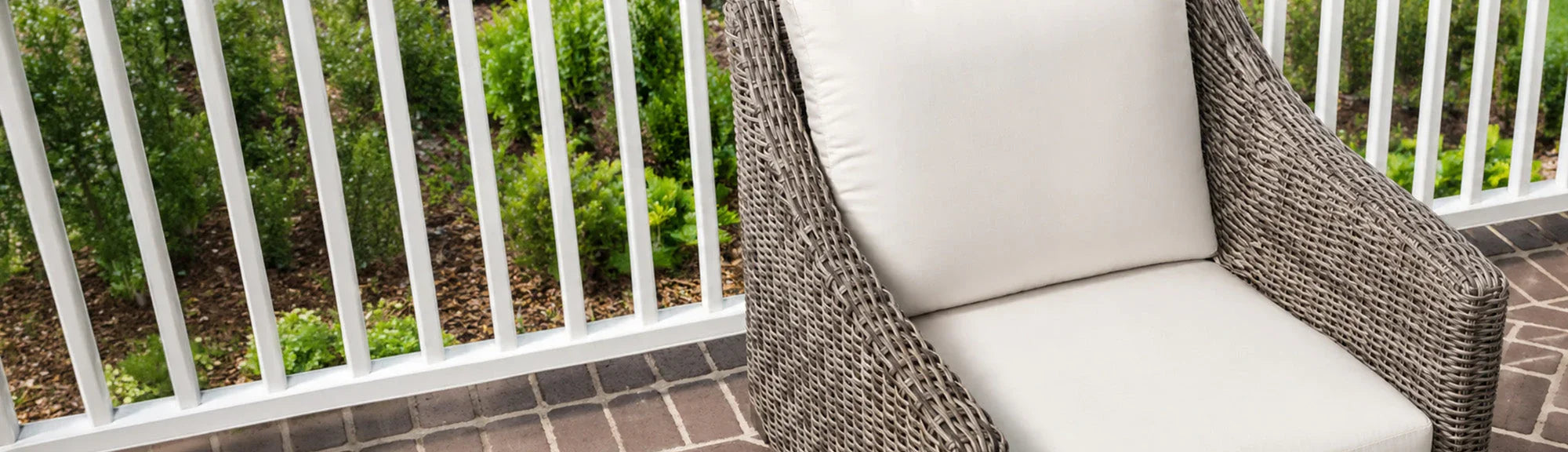
Cast and extruded aluminum dominates commercial patios for a simple reason: it's light enough for a two-person staff to rearrange between seatings, it never rusts, and the powder-coat finish resists chipping season after season. If I'm being honest, I'd take a stackable aluminum dining chair over almost anything else for a restaurant patio. It's boring, and that's exactly the point: very few materials survive three seatings a night the way aluminum does. Homecrest's commercial line, built in Wadena, Minnesota since 1953, is a good example of what purpose-built restaurant furniture actually looks like: steel crossbars, internal side rails, and a 5-year commercial frame warranty on top of the 15-year residential one. Wicker and wrought iron still have a place, though. Synthetic wicker over an aluminum frame reads warmer for a garden-style or bistro-style setting, though it takes more upkeep to keep looking sharp under daily guest traffic. In coastal spots with real wind, dense wrought iron resists getting blown off a patio in a way that lighter aluminum sometimes can't. Our broader breakdown of how to choose the best material for outdoor furniture goes deeper on the tradeoffs if you're comparing materials across a whole property.
Your Decor Is a Branding Decision Before It's a Budget Line
Wicker sectionals with loose ends, wine-stained cushions, and scratched glass tabletops all say the same thing to a guest, whether you mean them to or not: nobody here is paying attention. We've furnished patios for concepts as different as Hooters and Truluck's, and neither would have worked furnished like the other. A sports-bar patio and a white-tablecloth steakhouse patio are solving completely different problems, even though the furniture underneath, aluminum frames and Sunbrella cushions, can come from the same manufacturers. Sunbrella's library runs past 200 colors and patterns, and matching it to your actual concept, not just what happened to be in stock, is worth the extra week it sometimes takes.
Lead Times Make or Break a Launch Date
A launch date doesn't wait for furniture to show up, and a tight timeline is more common in this business than people expect, especially for a new opening or a spring patio refresh squeezed into a few weeks. In-stock commercial pieces generally ship within 14 business days domestically, and our Quick Ship cushion fabrics run 7-10 business days. Custom Sunbrella fabric or a nonstandard configuration adds two to four weeks, so if your project needs something specific, call earlier than feels necessary. Full details are in our shipping policy.
We Get Asked for Something Custom on Almost Every Project
Nearly every restaurant client eventually asks whether we can do something not listed on the website, and the honest answer is usually yes. An oddly shaped sidewalk patio, a specific cushion color to match a new logo, a run of bar-height seating along a railing that doesn't match any standard configuration: these come up constantly, and an off-the-shelf spec sheet doesn't always capture what a specific space actually needs. If you don't see exactly what you need in the catalog, contact us directly rather than assuming it doesn't exist.
Where to Start When You're Ready to Buy
Browse the site first to get a feel for what materials and configurations fit your space, then call us. Our Patio Buyers Guide is a reasonable starting point if you're new to sourcing at this scale.
Our roundup of the top outdoor furniture brands is worth a read too, if you want to know who actually makes the frames before you commit to one. Southern California restaurants are welcome to visit our San Diego Patio Showroom by appointment, and our Trade program is there for designers and restaurant groups who work with us regularly enough that it should be.
None of this is complicated once you've watched enough patios fail the same way, twice. The materials that survive real guest traffic aren't usually the most interesting ones in the catalog; they're the ones built for the six-month mark, the two-year mark, and the point most residential furniture would already be gone.
If you're staring down a launch date and a patio full of empty space, give us a call! We've done this enough times to know what actually holds up, and what just looks good in a catalog photo.
Reader Comments
Cornelius December 14, 2016
This piece of writing provides clear idea in favor of the new users of blogging,
that really how to do running a blog.
rosalba42 December 27, 2016
I don't agree, look at that:
http://www.consumerreports.org/cro/news/2014/03/patio-furniture-spend-less-get-more/index.htm
Patio Productions December 30, 2016
Thank you for commenting. I tried to find the outdoor furniture review mentioned in the article but it appears to not exist. Which is important because we would like to know what furniture was tested, the types of tests performed, and under what conditions.
We definitely agree with their advice and tips for shopping for outdoor furniture. They are the same tips we give to our own customers. Consumer Reports does a great job of educating consumers to make informed buying decisions.
And we definitely agree that price is not the best indicator of quality. Quality is the best indicator of quality. That is the reason we dedicate a lot of time on our blog into educating our customers.
BABMAR - MODERN OUTDOOR FURNITURE January 6, 2020
Great information, thanks for sharing blog on topic "Restaurant Commercial Outdoor Furniture".