How It’s Made: The Acapulco Chair - Part II
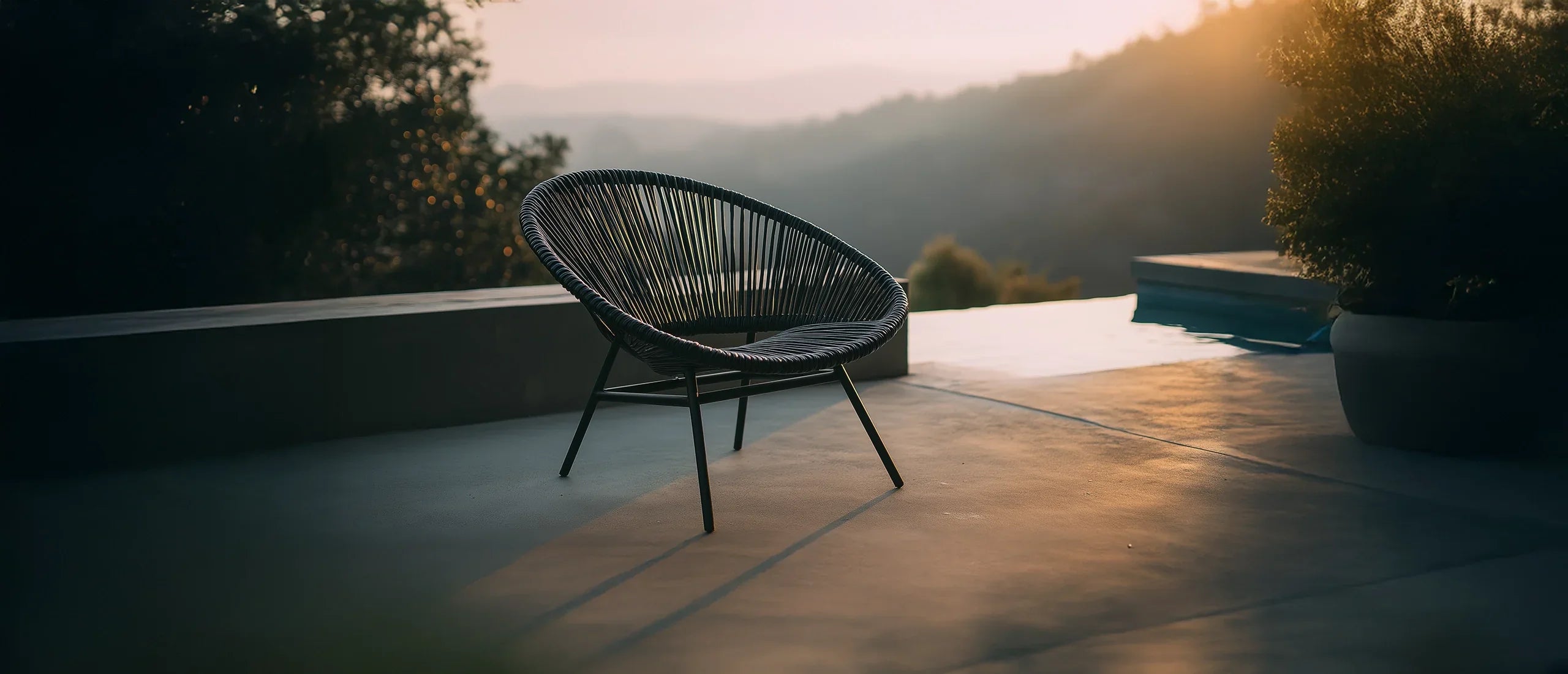
Many people wonder why Acapulco chairs command such a hefty price tag. The truth is, these chairs are hand-made and require an incredible amount of man-hours to create just one. Each piece is individually made starting with a frame and a single piece of cord. Attention to detail is just one of the aspects that set Acapulco chairs apart from generic machine-made furnishings.
This is the second installment of our Acapulco Chair Series. If you recall, Part I covered the eUPDATEnce of the Acapulco chair with a history behind the origins, inspirations, and advent. It's filled with relevant information that will help you appreciate this traditional piece and its place in world history.
The Iconic History of the Acapulco Chair - Part I
© METROCS
Check out the new Acapulco Collection!
Frequently Asked Questions About Making Acapulco Chairs
They’re hand-made, one at a time. Each chair is individually hand-woven by an artisan using a single cord on a prepared frame. The labor, precision, and finish quality separate true Acapulco chairs from generic machine-made pieces—paying for craftsmanship and longevity.
Steel frames for slim, strong support. While aluminum is lightweight, the chair’s three thin legs benefit from steel’s strength. Quality frames are powder-coated for rust resistance and all-weather use—modern upgrades over older, heavier frames that rusted in coastal climates.
One continuous cord, wrapped in rows. The artist ties off, stretches the cord to the outer rim, wraps the perimeter 3–4 times, then returns to the center—repeating row by row. Small spacing yields firmer support; larger spacing feels more flexible and “dippy.”
Choose HDPE over nylon or PVC. Nylon has moisture issues outside. PVC is common but weaker and environmentally harmful. HDPE cords are rounded, recyclable, fade- and scratch-resistant—often worth about $20 more for better durability and eco-minded performance.
Not bad—just less ideal for thin legs. Aluminum is light and stores easily, but slim three-leg designs can bend under pressure. Steel maintains the original slender look with sturdier support, then gets a rust-resistant powder-coat for outdoor longevity.
Tighter = supportive; wider = more give. More perimeter wraps produce smaller gaps and a firmer, more supportive seat. Fewer wraps widen the spacing for a looser, more flexible sit. Artisans tune spacing to balance comfort, airflow, and style.
Yes—watch a traditional weaving demo. The article features a video of an artisan weaving in Oaxaca. Seeing the meticulous, row-by-row process underscores why genuine Acapulco chairs command respect—and why we champion quality craftsmanship.
How to Make Acapulco Chairs
Acapulco Frames
The frames lay the skeleton of the actual chair. Typically, Acapulco frames are made from either steel or aluminum. Aluminum patio furniture is a great option for outdoor seating for various reasons. Their lightweight construction makes them easy to store during the winter months. The downside of this is that they can be more inclined to bend when large amounts of pressure are applied or when frames are required to be thin as in the case with the Acapulco chair.
For this reason, steel frames work better on Acapulco chairs. By no means am I saying that aluminum is an inadequate material. If you'll notice, the Acapulco chair stands on 3 supporting legs. These legs are thin. To keep the original slim look, sturdy steel frames are used to provide ample support and then powder-coated with rust-resistant materials for all-weather capabilities. The original Acapulco chairs were made using heavier frames that tended to rust in these coastal climates.
Every Acapulco Chair begins its life as a bare frame like this. Images courtesy © METROCS.
Hand-Woven Design
Here you can see a gentleman weaving an Acapulco chair by hand. © METROCS
Believe it or not, each Acapulco chair is hand-woven by an individual artisan who has mastered the craft. In this way, each chair is truly unique and personalized to the touch. Any item that is hand-painted or hand-crafted will require a steeper price but the artistic distinctiveness is well worth it. Machines are great but there's something about human art-work that cannot be duplicated or even replicated.
Working with a base frame, an artist wraps the chair row by row using a single piece of cord. Techniques used to weave the cords vary but generally, the artist will tie the starting piece to the frame and stretch the cord to the exterior egg-shaped perimeter.
From there, the artist will wrap the cord around the exterior frame 3-4 times before bringing the cord back to the center hole of the frame. The number of cycles around the exterior frame will determine the spacing between each cord. Smaller spacing will create a more supportive seat while larger spacing is more flexible and more inclined to dipping.
This video, shot by Israel Esteban Banuelos, demonstrates a man weaving an Acapulco chair in Tuxtepec, Oaxaca. To view more of his work, you can visit his Facebook Page here!
The video is incredible to watch and really helps you appreciate all the work that goes into making these chairs. I've heard some people remark that they could "make it themselves" when glancing at the price point. Once you see this video, you may want to reconsider as it is a tedious and skillful task.
Understanding how Acapulco chairs are made makes it easy to understand all the work and effort that goes into making these beautiful chairs.
Materials Used for Cord
Generally speaking, there are 3 types of materials used in Acapulco cording; nylon, PVC, and HDPE. Nylon is a well-known material for its durable qualities. However, it is also conducive to water and moisture. For this reason, they have trouble in outdoor conditions, especially in coastal/tropical regions.
PVC is a very popular material used in wicker furniture. The downside to PVC is that it is harmful to the environment and it's a weaker material. High-Density Polyethylene, or HDPE for short, is an upgrade from lower-quality PVC materials. Instead of a flattened string, HDPE is spun into rounded cords to make Acapulco chairs. Unlike PVC, HDPE is recyclable, fade resistant, and scratch resistant. It might cost an extra $20 for this type of chair but it's well worth your investment.
© METROCS
Acapulco chairs have been adapted to other styles of furnishings, including rockers, baby Acapulco's, dining tables, chat sets, & more! Click here to Shop for Acapulco Furniture.
Continue Reading the Acapulco Series:
- The Iconic History of the Acapulco Chair - Part I
- How It's Made: Acapulco Chairs - Part II
- Add Zest to Any Space with Acapulco Chairs – Part III
- Spin Offs of the Acapulco Chair - Part IV
- The Debate Between Original & Replica Acapulco Chairs - Part V
About the Author
Cheryl Khan is a social butterfly, design geek, and weekend tanner. She enjoys lounging outdoors on a chaise with al little shade and a good breeze. She can't wait to get her hands on an Acapulco rocking chair!
Reader Comments
Israel Esteban Bañuelos November 2, 2014
OMG you used my video, i 'm very happy to see this, great article.
saludos desde Tuxtepec, Oaxaca, México!!!
Patio Productions November 4, 2014
Hi Israel, it's a really great video that shows how much time and effort are taken to build just one of these Acapulco Chairs. As soon as people realize that each of these chairs is hand woven, they immediately begin to appreciate the quality of the chair. Is this actually you in the video or are you video taping a friend?
Carol Ann Krimmer April 14, 2015
I have an old Acapulco chair, but need to re-string it. I found the cording, and am pretty handy, but Im wondering about the initial knot used, and how it is finished /tied off at the end? any thoughts
Nick October 24, 2015
Hi there - where did you find the cord? I am in the same boat and looking for material to restring it.
Carol Ann April 28, 2015
nice article, I have an old Acapulco chair and have bought the cord to re-wrap it-any advice on how to knot it off to begin the wrap and how to knot off to finish it?
THANKS!
heating and air conditioning August 17, 2015
It's best to participate in a contest for among the finest blogs on the web. I'll advocate this website!
Grant Atkinson-Smith July 9, 2016
I too have an old Acapulco chair I want to restring but I'm having trouble finding cord suppliers/stockists for Europe. Anyone know where to get PVC cord in Europe, ideally the UK? I know Innit supply cord but they are Canadian and want to charge me $75 just for delivery!
Patio Productions July 12, 2016
Unfortunately the pricing for vinyl cord can be quite high simply because of shipping costs. In some cases it might be cheaper just to buy a new one instead of trying to restring an old chair. But if your heart is set on doing it yourself, be prepared to pay a little extra if necessary.
Paulo Xavier February 25, 2018
Hi,
I want to build some Acapulco chairs, but I don't know the name of the material when I go to shop. Can you tell me for PVC and HDPE?
Thanks
Patio Productions February 26, 2018
Some manufacturers use PVC, others use HDPE. It all depends on what you're looking to get out of the material. PVC is less dense than HDPE and is prone to drying and cracking after a year or two of sun exposure. HDPE on the other hand, given the high density, will last much longer and maintain color better over time. HDPE is definitely the better choice if you're looking for a material that will last for 5+ years. If you just want something that you can use now and replace in a year or two, PVC could be all you really need.
Megan January 6, 2019
Where can I find a frame to buy to make my own Acapulco chair? I’ve scoured the internet and can’t seem to find any company that sells just the frame.
Patio Productions January 12, 2019
Thank you for your comment. That is a very good question.
I think your best bet would be to look for used frames at yard sales and such. The frames themselves, if made out of wrought iron or stainless steel, can still hold up for many more years after the strapping wears out.
As far as getting a brand new frame only, that is going to be difficult because most manufacturers have their frames made AND woven overseas. The weaving process is a handmade process and there simply isn't many people in the US willing to do that job. The only people that know how to weave Acapulco chairs tend to specialize in antique furniture restoration.
Another option is to call local patio furniture stores and ask if they have any old frames they want to get rid of.
Good luck!