Article: The Ultimate Patio Umbrella Buyers Guide
The Ultimate Patio Umbrella Buyers Guide
Patio umbrellas may be one of most important outdoor decor pieces you'll make. A beautiful, high-quality patio umbrella is certainly among the most desired outdoor furniture accessories because it brings your whole patio look together. And these days, they come in a wide-ranging selection of sizes, styles, weights, shapes, and forms. And how important is it to get a high-quality one? Well, if you’ve ever purchased a cheap personal umbrella (or watched any cartoon umbrella-related antics), you know you're in for a bad surprise. But on the flip side, investing in a quality outdoor umbrella means more outdoor time spent enjoying conversations with close friends … instead of chasing umbrellas across the yard.
The goal of this article is to make sure you’re not disappointed with your next patio umbrella. So, you'll learn everything you need to know about patio umbrellas! If you read to the end, you’ll practically be an outdoor umbrella expert!
FAQs: Patio Umbrella Buyer’s Guide
Let the canopy extend ~2 ft past the table on all sides. Quick guide: 30–36" table → 6–8' umbrella; 38–48" table → 9–11'; 54–60" table → 11'+. Use similar coverage for loungers/chair clusters by measuring their footprint so guests stay shaded without an oversized look.
Aim for ≥7' height and tightly match base/hole diameter. Most poles are ~1.5–2.5" diameter. Match your base (or table hole) as close as possible, with the opening no more than 0.25" larger than the pole. Taller guests need clearance; many poles are height-adjustable. Beach umbrellas are slimmer—double-check specs.
Weight = stability. Size your base to the canopy. Guide: 20 lb for 6' table umbrellas; 30 lb for 6.5'; 40 lb for up to 4.5' freestanding (or 7.5' table); 50 lb for up to 7.5' freestanding (or 9' table); 70+ lb for most freestanding up to 11'. In high winds, consider a commercial cantilever.
Market, tilt, and cantilever; table or freestanding. Market = classic form; Tilt adds a hinge to chase moving sun; Cantilever hangs over seating, often with 360° rotation and larger shapes. Table umbrellas go through the tabletop; freestanding models suit lounges, sofas, and bistro sets.
Tilt hinge, crank lift, and double-vented canopies. Tilt avoids shuffling chairs as the sun moves. Crank systems are easier than pulley lifts. Double vents relieve wind pressure and help heat escape. Add umbrella lights to extend evening use without firing up big exterior fixtures.
Outdoor-rated fabrics; aluminum or flexible fiberglass frames. Seek all-weather, UV-resistant, breathable fabrics (e.g., well-known outdoor textile makers). Aluminum offers durability; fiberglass flexes in wind. Wood has classic appeal but generally needs more care and isn’t as weather-ready as aluminum.
Treasure Garden, Bambrella, California Umbrella, Hospitality Rattan. These makers are highlighted for quality, durability, and outdoor performance across styles and price points—helpful starting points when you’re comparing models and features.
We're only laying the groundwork here, explore further to find expert advice in the ultimate patio umbrella buyers guide.
Article Topics (Click to Jump to Section)
| Patio Umbrella Basics | What are patio umbrella basic components? |
| Patio Umbrella Dimensions | Know Your Patio Needs What Size Patio Umbrella Should I Buy? Patio Umbrella Pole Diameter Umbrella Base |
| Types of Umbrellas | Market Umbrellas Tilting Umbrellas Cantilever Umbrellas Table & Free-Standing Umbrellas |
| Patio Umbrella Features | Tilting Umbrellas Double-Vented Umbrellas Crank or Pulley Systems Patio Umbrella Lights |
| Fabrics & Materials | Frame and Fabric details and recommendations |
| Frequently Asked Questions | How to Measure Patio Umbrella Size What Size Patio Umbrella for 48" Table? What Size Patio Umbrella for 42" Table? What Size Umbrella for 54" Table? Who Makes the Best Patio Umbrellas? Patio Umbrella Wood vs. Aluminum |
Patio Umbrella Basics
Before get in too deep, lets define the basic components of a patio umbrella (so you're not surprised by any terms below). Outdoor umbrellas have 3 basic components:
- Canopy: the main part of the umbrella that unfurls to block the sun or rain
- Pole or Arm: the sturdy part the canopy is attached to, often can be adjusted to change the umbrella's overall height
- Base: holds up the pole or arm, providing stability

Patio Umbrella Dimensions
These days, patio umbrellas come in all shapes and sizes. Like … a dizzying amount. So, how do you choose the right size umbrella for your outdoor space? Well, it primarily comes down to three things. You need to choose the right size for your umbrella's canopy, pole, and base. But more importantly, you need to understand your outdoor space's purpose and size. Not to mention your budget.
1) Know Your Patio Needs
Take a few moments to think about your patio. Better yet, take a measuring tape out there and answer these questions:
- How is your outdoor space being used? Are you trying to create shade for one chaise lounger? Or do you have a full patio dining area?
- How much space do you need to shade? Use that tape measure and get specific.
- What are you space details or restrictions? Does your patio dining table have an umbrella hole? Or is your area particularly windy?
Great. Now that you know what design challenges you're solving with a patio umbrella, let's dig in!
2) What Size Patio Umbrella Should I Buy?
Let's start with one of your most important decisions: canopy size. This is one of the most important practical decisions you'll make. A too-small canopy will leave your guests all sunburned or rain-soaked. And choosing an oversized umbrella will be overwhelming and throw off the balance of your outdoor arrangement.
So what's the right size? Your umbrella should typically extend over your dining table by 2 feet on each side. If you have a 4-foot rounded table, this means you need an umbrella that measures 8 feet in diameter. You can use these same measurements for chaise lounges or clustered club chairs. Just use their combined square footage.
- Table = 30-36 inches -- Umbrella = 6-8 feet
- Table = 38-48 inches -- Umbrella = 9-11 feet
- Table = 54-60 inches -- Umbrella 11 feet or larger

3) Patio Umbrella Pole Height and Diameter
Next up? Choosing a patio umbrella pole with the right diameter and height. Again, this decision has both a functional and aesthetic impact. Having to stoop down under an umbrella's edge can be a constant annoyance.
Your patio umbrella pole diameter is crucial to your umbrella's stability. Maximize your umbrella's stability by making sure your umbrella pole diameter and base (opening) diameter are as close as possible while still fitting. If you're installing your umbrella in a table with an umbrella hole, this same idea applies. We looked through our collection of patio umbrellas. Most have a pole diameter of at least 1.5″, with some as high as 2.5″. So, if you choose an umbrella with a pole diameter of 1.5″, your base should have a hole diameter of at least 1.5″ (and 1.75″ at the most). As a rule of thumb, your base diameter should not be more than .25″ larger than your umbrella pole.
Pro Tip: Beach umbrellas are slimmer than patio umbrellas, make sure you double check before purchasing!
Now for choosing the right umbrella pole height. You have a little bit of a needle to thread on this one. You want enough clearance so that taller guests don’t have to stoop down when they're under the umbrella. Still, it can’t be so high that the shade covers your dog instead of you! In general, you want your umbrella to be at least 7 feet tall. Many umbrella poles have adjustable heights. And you can look for patio umbrellas with tilting or cantilever features to adjust where the shade lands. We’ll talk about that in the section below.
4) Umbrella Bases
Repeat after me: "My patio umbrella base is functional as well as decorative!" It's actually one of the most important factors. If your base is not heavy enough, your umbrella will flop and fly around in a strong wind. Here are our suggested Umbrella Base Weight Recommendations:
- 20 lb. Base - Used for smaller table umbrellas. Only suitable for 6' table umbrellas.
- 30 lb Base - Used for 6.5' table umbrellas.
- 40 lb Base - Minimum weight for freestanding umbrellas up to 4.5'. It can be used for table umbrellas up to 7.5'.
- 50 lb Base - Accommodates up to 7.5' free-standing outdoor umbrellas. It can also be used for table umbrellas up to 9'.
- 70+ lb Base - These bases can be used for most free-standing umbrellas up to 11'. If you live in areas that experience high winds, you should consider a commercial cantilever outdoor umbrella.

The 120 lb. Aspen Umbrella Base with Wheels by Treasure Garden
Those Santa Ana winds can wreak havoc on a backyard party. Don't be that host who has to stand on the base of the patio umbrella every time the wind picks up. Instead, do yourself a favor and order one of these weighted patio umbrella bases that won’t move!
Pro Tip for Patio Umbrella Shopping
We highly recommend buying your patio umbrella in person, if possible. Being able to pick out an umbrella that’s the perfect fit for your patio while also finding the right base will make your life much easier in the long run. If you're in the San Diego area, stop by our store. We'll make sure you have the insider deets to make all the right choices.

Types of Umbrellas
So now you've sized up your patio umbrella. Let's look at the types of patio umbrella you can choose from! And I gotta say, you've got quite a few options. Choosing the right patio umbrella is like picking the perfect sidekick for your outdoor adventures. It's not a decision to be taken lightly, but don't worry, I've got your back. And trust me, when you're lounging in the shade with a cool drink in hand, you'll be glad you took the time to find your perfect match.
1) Market Umbrellas

Market umbrellas are your simple, straightforward patio umbrella style. You've seen them on patios, at outdoor restaurants, or over chaise loungers at the pool. "Market umbrella" is just a broad term for umbrellas made in this simple style. Their canopy sizes range from 6 to 16 feet.
Now, that's not to say market umbrellas can't look great or have nice features. Some have a tilting function (see below), and the range of colors, styles, and materials is incredibly diverse. The market umbrella is the go-to choice for folks who want reliable shade and a timeless look in their outdoor oasis.
Pictured: the 7.5 ft Octagon Market Umbrella with Fiberglass Ribs by Galtech International
2) Tilting Umbrellas

A tilting umbrella is basically a subset of market umbrellas, but with one super-practical feature: it has a hinge on the pole that lets you tilt the canopy.
You know that really unfortunate moment when the sun slides juuuuust low enough in the sky to slip beneath your umbrella's edge and stabs your eyes with blinding rays? Well, that's one great reason to get a tilting umbrella. Another great reason? You don’t have to play musical chairs every 30 minutes to remain in the shade. A tilting umbrella lets you move the umbrella instead of the party! The tilt feature is a simple game-changer. Definitely worth the money.
Pictured: the 11ft Octagon Custom Auto Tilt Umbrella by Treasure Garden
3) Cantilever Umbrellas

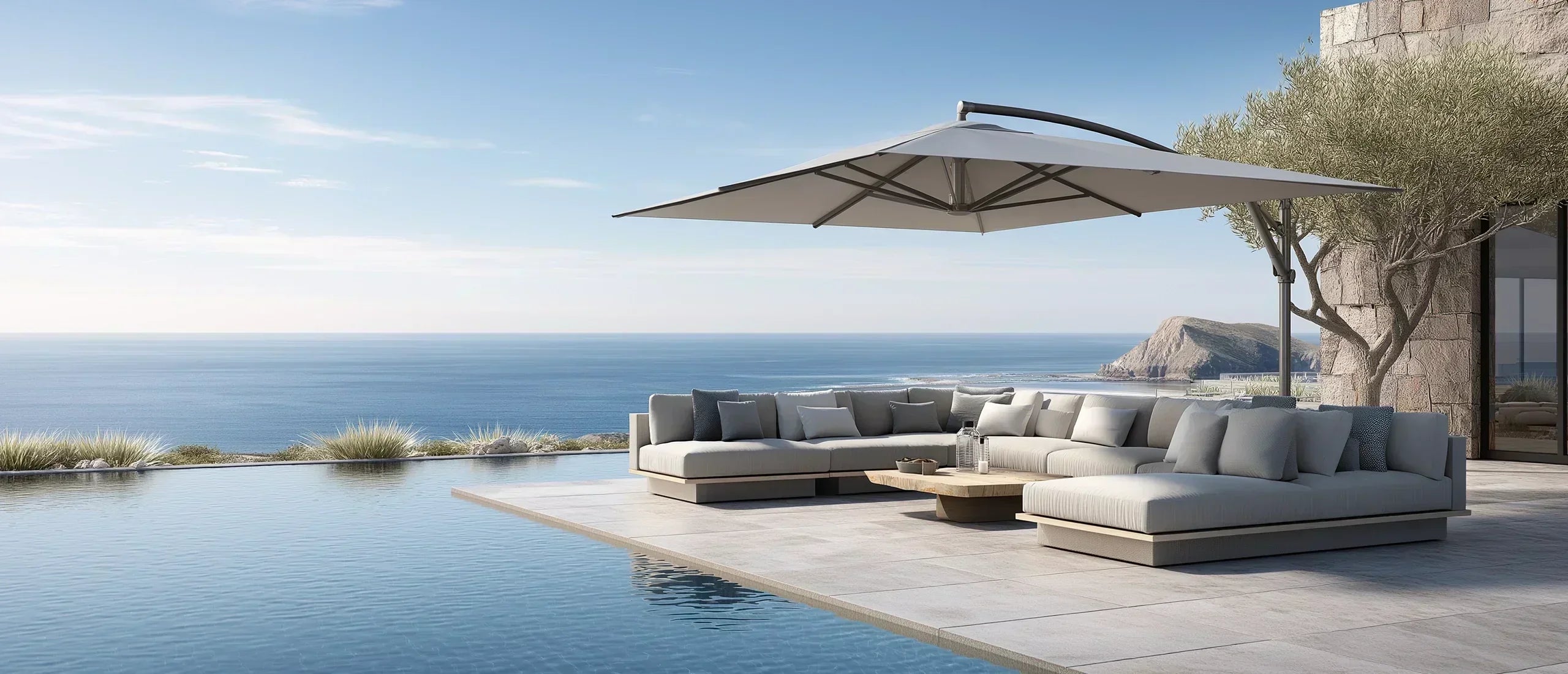
Now, let's talk about another shade superstar: the cantilever umbrella. These are the ones that look like the umbrella is stooping way over to stretch their canopy's shade even farther. Cantilever umbrellas are the deluxe patio shade-makers, and are often used to furnish Five Star Hotels.
So, what makes them stand out from the crowd? Mainly, they've got a curved or jointed pole instead of the traditional straight pole of a market umbrella. That's why it looks like it's doing a fancy yoga pose! That pole shape allows the canopy to hang freely over the space you want shaded, without the pole getting in the way of your furniture or your conversations.
Pictured: the 10x13 AKZ PLUS Cantilever Rectangular Umbrella by Treasure Garden
Cantilever umbrellas often come with a 360-degree rotation feature. So, as the sun moves, you can swivel that umbrella around to keep the shade right where you want it. Plus, cantilever umbrellas often allow additional canopy shapes and sizes. This may be your best bet for covering a larger outdoor dining table or a group of clustered chairs. And their unique off-set base allows many cantilever umbrellas to be tucked away neatly when not in use.
Cantilevers are the ultimate option for those who want the best of the best. The heavy base helps stabilize it against wind. And a high-quality cantilever will sport heavy-duty, weather-resistant materials for everything from frame to fabric.
Our recommendation: The 10′ Deluxe Square Cantilever Umbrella is one of the most popular models
4) Table & Free-Standing Umbrellas

This one's pretty self-explanatory. Table patio umbrellas fit through a hole in your outdoor dining table. Most tables use a standard 1.75″ hole for patio umbrellas, but it’s always a good idea to check to make sure. 1.75″ is the standard size for Treasure Gardens Umbrellas. Sometimes, umbrella poles are 2″. These work well for dining tables.
Free-standing outdoor umbrellas are ideal for poolside furnishings. Chaise loungers, outdoor sofa sets, bistro sets. You get the idea.
Pictured: the Topaz 48 inch Round Dining Table with Umbrella Hole by Jensen Outdoor

The 9ft Octagon Auto-Tilt Umbrella by Treasure Garden
Patio Umbrella Features
Are you ready to geek out over patio umbrella features? These little extras are like the secret ingredients that take your shade game from "meh" to "oh yeah!" They're the toppings on your sundae, the sprinkles on your donut, or the cherry on top of your already awesome patio setup. (Hmmm … I'm thinking I should grab some lunch soon.)
Tilting Umbrellas
Okay, yes, I put tilting umbrellas in two different places in this article. It's defining feature - the tilting hinge - is just that good. Being able to adjust the angle of your canopy gives it so much more utility as the sun moves across the sky. This simple-to-use feature keeps you from having to move your umbrella or other furniture to stay in the shade. All my thumbs are up.
Crank or Pulley Lift Systems
Alright, let's talk about a patio umbrella feature that gets overlooked a lot: the crank and pulley lift systems. Don't sleep on this, folks, because your choice here will come into play nearly every time you use your umbrella. Why? Because it's how you open and close your umbrella canopy.
So, let's talk about the crank lift system first. The crank is the easier option of the two, but usually costs a touch more. You just grab the handle and give it a few turns. Boom! Canopy is raised or lowered. There's not much more to explain here. It's so easy, even your great-aunt Mildred could do it with her eyes closed (no offense to Great-Aunt Mildred, of course).
On the other hand, we have the pulley lift system. This one's for those who like a bit of old-school charm with their shade. Or those who want to save a few bucks. You simply tug on a rope or cord to open your umbrella. Sometimes these can be a bit fiddly to tie into place, but most modern pulley umbrellas are well-designed.

Double-Vented Patio Umbrellas
The double-vented umbrella is modern technology's response to the patio umbrella's age-old enemy: high winds. Have you ever seen a strong gust knock over and ruin a nice outdoor umbrella, or completely invert it? Or have you been under a patio umbrella on a particularly hot day and felt like your umbrella was actually trapping the heat in with you? Well, double-vented umbrellas help prevent both of these by adding a clever little piece of canopy material at the top.
You see, "double-vent" refers to this second piece of material, which is designed to let air flow not only over the top of your umbrella, but through it, as well. Think of it like a tiny wind tunnel. The double vents work their magic by relieving the pressure underneath the canopy, preventing your umbrella from turning inside out or performing an impromptu Mary Poppins impression. Plus, the added ventilation helps dissipate trapped heat more efficiently.
These days, double-vented umbrellas are pretty common. For premium brands, it might be their only option because it adds to the longevity of the canopy.
Patio Umbrella Lights
Okay, so a patio umbrella light isn't exactly a feature of the umbrella itself. But just it's too cool and useful to leave out. The Vega-L Umbrella Light keeps the party going even if the sun decides to call it a day. It just adds so much additional functionality to the umbrella you already love using so much. Instead of cranking your canopy closed and heading inside to flip on your external lights, just turn these bad boys on. And they're surprisingly inexpensive and easy to install. I love mine. You will, too.
Photo: the Vega-L Umbrella Light by Treasure Garden

Explore the Top Patio Umbrella Accessories for your umbrella!
Choosing Fabrics & Materials for Patio Umbrellas
Here's an old outdoor design rule: the resilience and style of your patio umbrella is only as good as the materials its made from. Just like the fabrics of your outdoor furniture, your patio umbrella's fabrics and materials will need to meet some all-weather requirements.
If you live in a particularly windy area, you may want to consider fiberglass umbrellas. They're designed with flexibility in mind, so they bend slightl in the wind instead of just breaking. Aluminum is another highly-durable option. Some people really enjoy that classic wooden pole look. I'm not saying that's a bad choice, but they certainly don't last as long - or resist weather as well - as aluminum.

For umbrella fabrics, you’ll want to look for a few key phrases that will indicate a quality outdoor umbrella. All-weather, waterproof and UV resistant fabrics, and breathable designs that prevent mold and mildew are highly recommended. Sunbrella is the most well-known name in outdoor fabrics. They began making awnings in the early 1960s. They now make fabrics for umbrellas as well. Learn more about Sunbrella Fabrics.
Just like the fabrics of your outdoor furniture, you need to ensure that the fabrics and materials used on your umbrella meet all-weather requirements. If you live in windy areas, you may want to consider fiberglass umbrellas that are flexible and are designed to bend slightly. Likewise, aluminum is very durable and is still a viable option.
Buy Patio Umbrella Covers Here.
For more insight, I'd suggest these Additional Patio Umbrella Resources:
- Buying Guide: Find The Best Outdoor Patio Umbrella For Your Home
- What to Look for While Shopping for Some Shade
- How to Pick a Patio Umbrella That Performs
More Patio Furnishing Buying Guides
- The Patio Furniture Buyer's Guide
- Outdoor Wicker Furniture Buying Guide
- A Buyer's Guide to Wrought Iron Patio Furniture
Umbrellas

Auto Tilt 8' x 10' Rectangular Aluminum Market Umbrella
$479.00

Push Button Tilt 7.5' Octagon Aluminum Market Umbrella
From $219.00

Auto Tilt 11' Octagon Aluminum Market Umbrella
$499.00

Santa Ana 6.5' Square Aluminum Cantilever Umbrella
$2,149.00

Santa Ana 10' Round Aluminum Cantilever Umbrella
$2,119.00

Santa Ana 6.5' Square Aluminum Market Umbrella
$779.00